Guides
Part of Getting content approvals right the first time
What a content approval platform must record before you trust it
Best content approvals platforms 2027: what a review surface has to record, why comment threads on frames beat email, and how to test one before you depend on it.
The surface you review on decides what you can prove afterward. That sounds like an administrative point and it is the difference between being able to answer a question about a campaign a year later and being able to say only that everyone was happy at the time.
No products are named here. The properties below belong to the category and outlast any particular service. How the review should be run is in content approvals.
What to take away
- A review surface has one job the alternatives do not do: tie a specific comment to a specific moment in a specific version.
- Email review fails not because it is old but because it has no version identity, so two people are looking at different files and neither knows.
- Whatever surface you use, the record you actually need includes the published post, which no review tool captures for you.
What a surface has to record
| Item | Why it matters later | Where it usually goes missing |
|---|---|---|
| Version identity | To know which cut a note refers to | Files named "final" three times |
| Comment anchored to a timecode or region | To remove ambiguity about what was meant | Prose notes in an email body |
| Who commented, and when | To reconstruct who asked for what | Forwarded threads with the attribution stripped |
| Who approved, and when | To show the decision was made | Approval given verbally in a meeting |
| The consolidated note set sent to the creator | To show what the creator actually received | Only the internal thread survives |
| The creator's response | To show what was agreed rather than requested | Answered in a different channel |
| The published result | Because disclosure is a property of publication | Nowhere at all |
The last row is the one review tools do not solve. An approval surface holds the file. What a viewer saw is a separate artifact, and someone must capture it deliberately.
That is a process step, not a feature. It is covered in contracts and disclosure. The FTC's material on effective disclosures in digital advertising sets out what the capture must show.
The categories, honestly
Email with attachments. Universally available and structurally unable to keep a version straight. Every attachment is a fork. It survives in small teams because everyone remembers, and it fails on the campaign where someone is on leave.
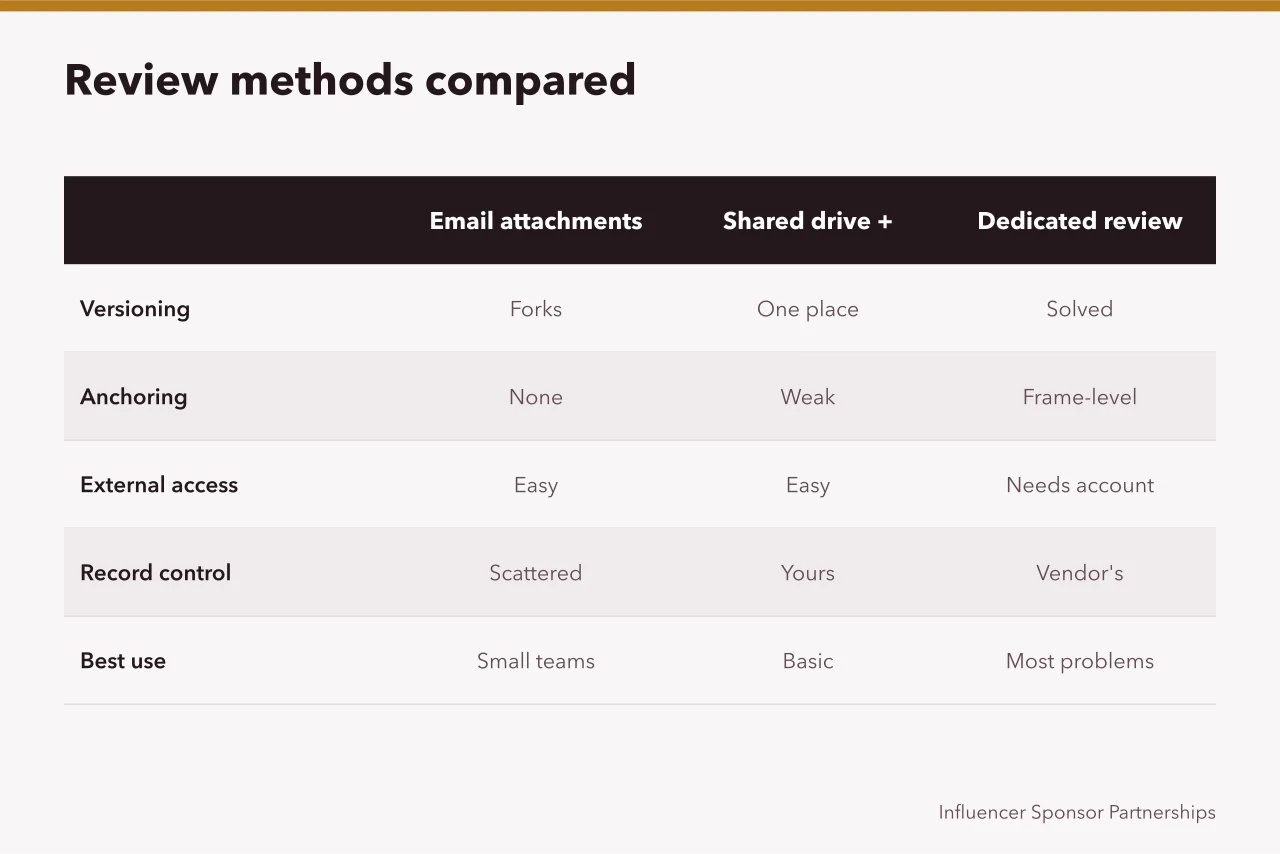
A shared drive plus a document of notes. Better, because there is one place. Still weak on anchoring: a note that says "the bit near the middle" costs a round.
A dedicated review surface with frame-level comments. Solves anchoring and versioning, which is most of the problem. Introduces two new ones: people outside your organization need access, and the record now lives somewhere you may not control.
A project tool with an approval step. Good at status and deadlines, weak at the content itself. Useful alongside a review surface, poor as a replacement.
A platform's own collaboration tools. Convenient where the content will be published, and limited to that platform's formats and to whatever the operator decides to keep.
None of these is the answer on its own. The common failure is using two at once for the same asset, so that the notes live in one place and the decision in another.
Access is the constraint people underestimate
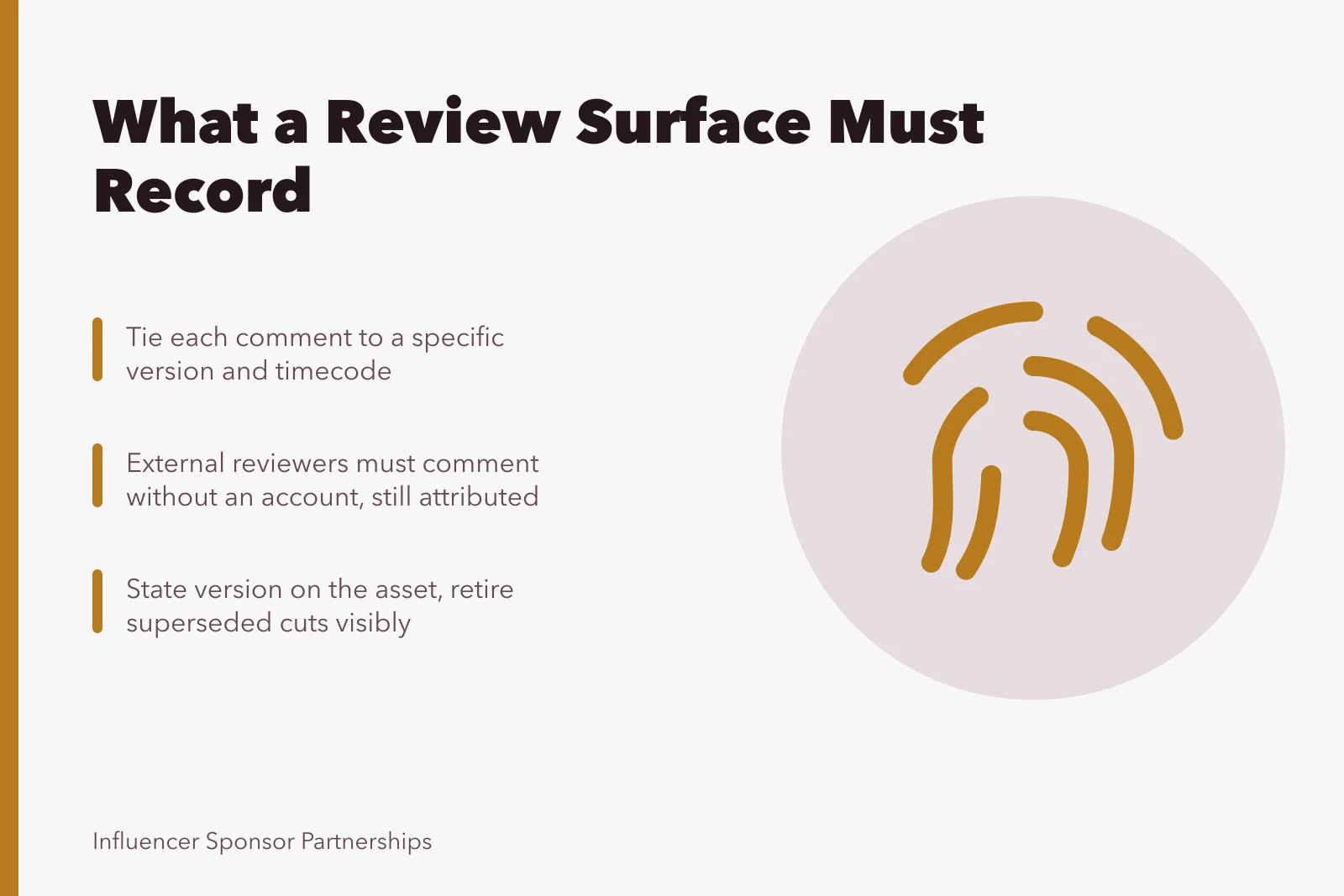
Your reviewers are internal. Your creators are not, and neither are their editors, their managers, or the agency in the middle. A surface that requires an account, a license and a login for each of them will be bypassed, and the bypass will be email.
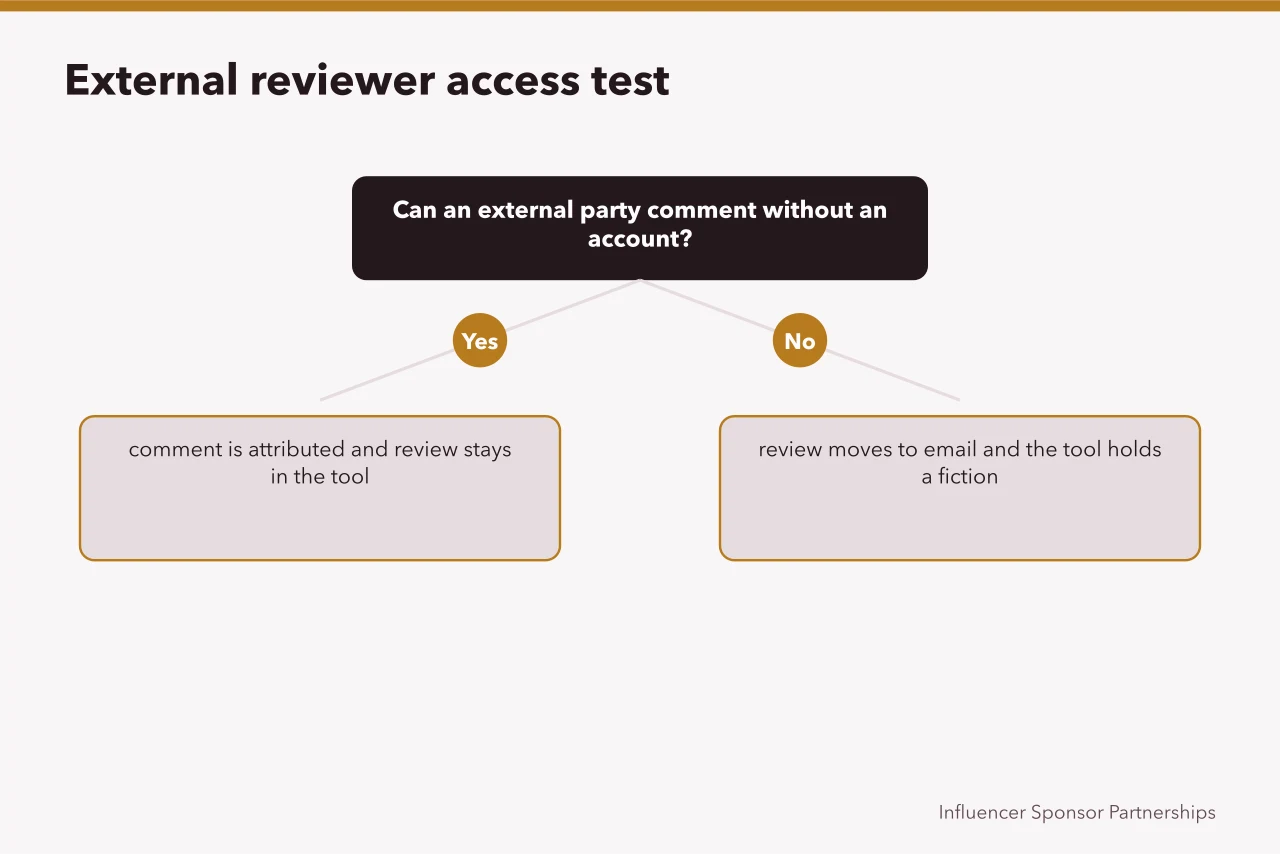
Ask, before committing: can an external party comment without an account, and does their comment still get attributed? If the answer is no, expect the real review to happen somewhere else and the tool to hold a tidy fiction.
Version discipline, which is not a feature
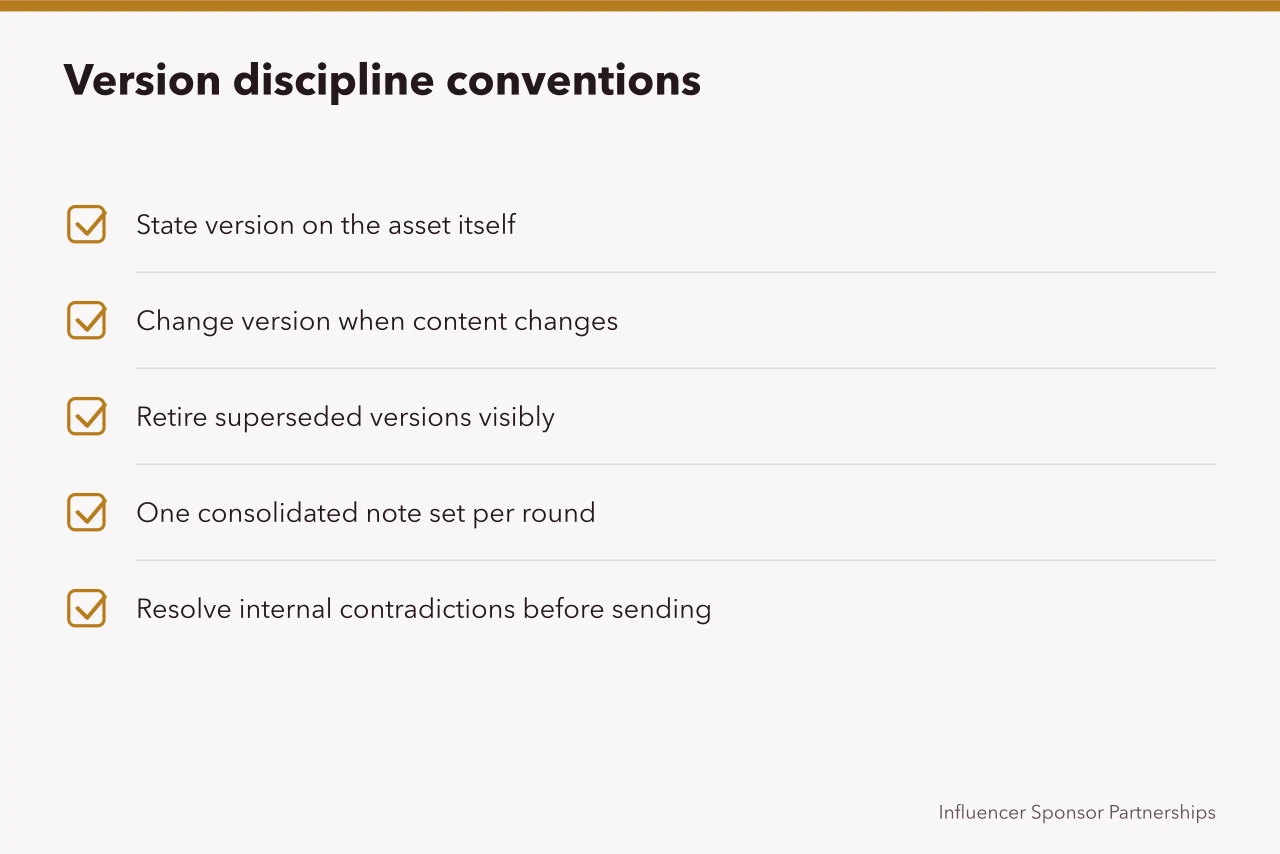
A review surface works by convention, not capability. State the version on the asset itself, not only in a file name. Change the version when content changes, not when the file is touched. Retire superseded versions visibly.
The problem is old and well understood as version control. That discipline transfers even when the tools do not.
One more convention worth adopting: one consolidated note set per round, sent once, with internal contradictions already resolved. A surface that lets six people comment independently makes it easier to skip that step, which is how a good tool produces a worse process.
Testing a surface before you rely on it
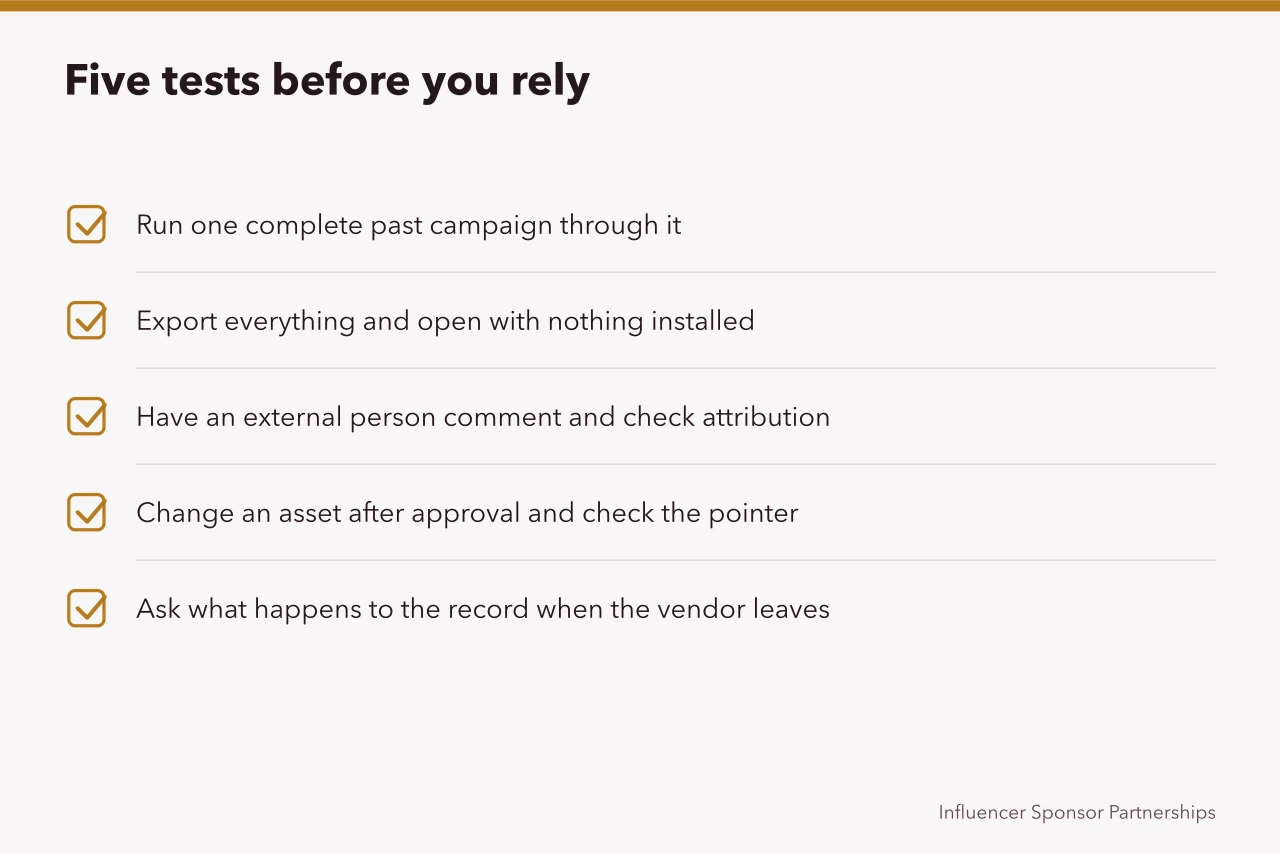
- Run one complete past campaign through it, including the awkward part, and see what the record looks like at the end.
- Export everything and open the export with nothing installed.
- Have someone outside your organization comment and check the attribution survived.
- Change an asset after approval and see whether the approval still points at the version it approved.
- Ask what happens to the record when the vendor relationship ends.
If the first test produces a record that cannot show which version was approved, by whom, and on what date, the surface is a workspace rather than a record, and you need both.
What it cannot fix
A review tool will not name who holds a decision right, merge contradictory notes, or decide what your brand will claim.
Those get settled before anyone opens a file, in campaign briefs and against priorities in strategy and objectives. A better surface on an undecided campaign yields a well-documented argument.
Bottom line
Choose a review surface for version identity, anchored comments and attributed approvals, and check that people outside your organization can use it without an account. Keep one consolidated note set per round as a convention rather than relying on the tool. Then add the step no tool provides: capture the published post, dated, beside the approval record.
Common questions
Is a dedicated review tool worth it for a small team?
Often not. A shared folder with a strict version convention and timecoded notes gets most of the benefit. Buy the tool when access and volume are the bottleneck.
Should creators be required to use the brand's surface?
Ask rather than require, and make it free and simple for them. A requirement that costs a partner money or time gets priced back to you.
What about reviewing on the platform where it will be published?
Useful as a final check on how it renders. It is not a substitute for a record, because you do not control what the operator retains.
How long should review records be kept?
Long enough to answer a question after the campaign ends and after the usage term expires. Ask your lawyer what applies to you.
What is the most common gap?
No capture of the published post. Almost every process holds the approved file and almost none holds what a viewer saw.