Costs
Part of Getting content approvals right the first time
Which content approval note actually changes what gets fixed
Content approvals examples: weak review notes rewritten as usable ones, sorted by the kind of objection they carry and what each one has to contain.
The difference between a review that takes two rounds and one that takes six is almost never the reviewer's taste. It is how the notes are written. A note that states a preference produces a guess; a note that states a constraint and a reason produces a fix.
What follows is a set of paired examples. Nothing here is a real campaign or a real brand. The process these notes live inside is described in content approvals.
What to take away
- A usable note names the problem, the reason, and whether it is a requirement or a preference.
- Reviewers who cannot say why they object will describe a solution instead, and their solution is usually worse than the one the creator would have found.
- The most damaging note is the one that rewrites a creator's voice for no stated reason.
The anatomy of a note that works
Four parts. Miss one and the round repeats.
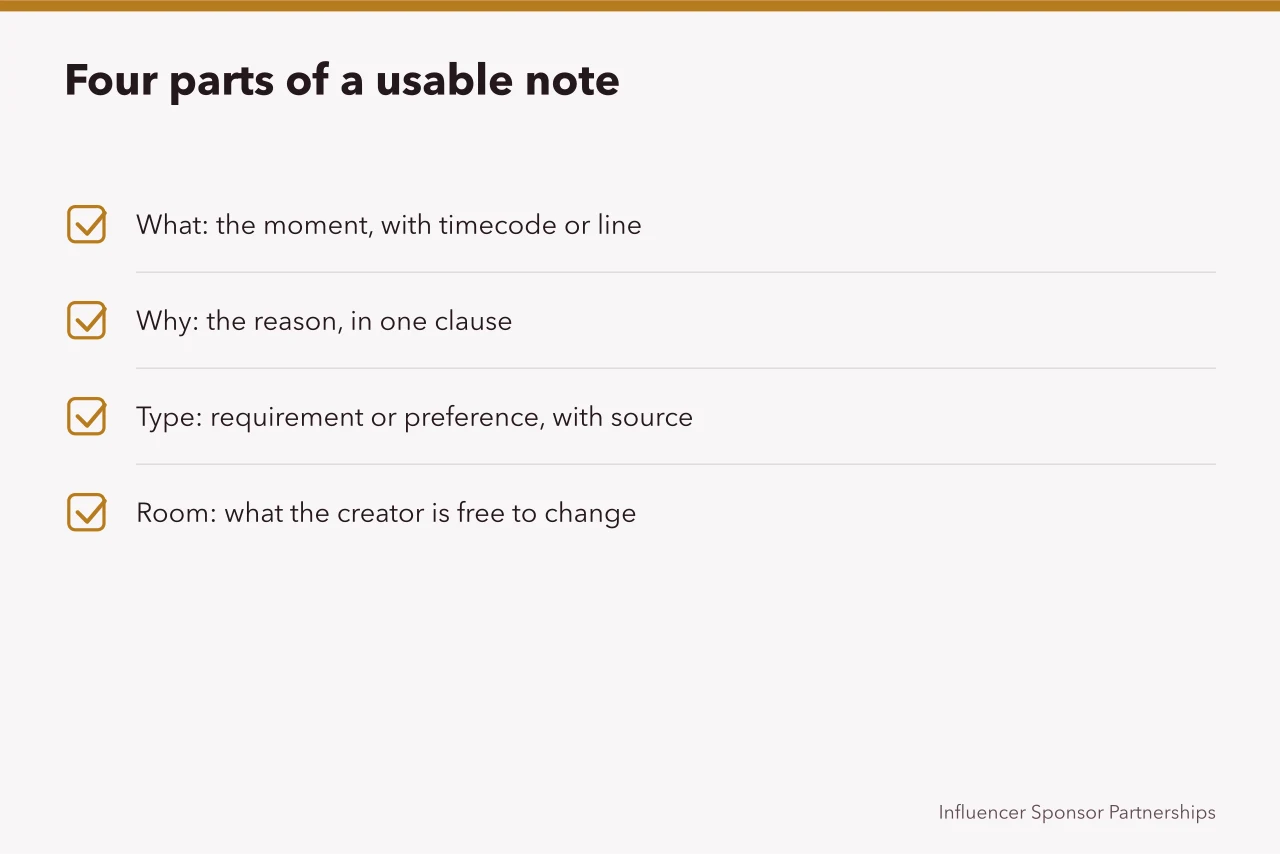
What. The specific moment, with a timecode or a line reference. Why. The reason, in one clause. Type. Requirement or preference. Requirements have a source: a rule, a legal position, a written brand standard. Room. What the creator is free to do about it.
The fourth part is the one people leave out, and it is what separates a note from an instruction.
Claim notes
Weak. "We can't say this."
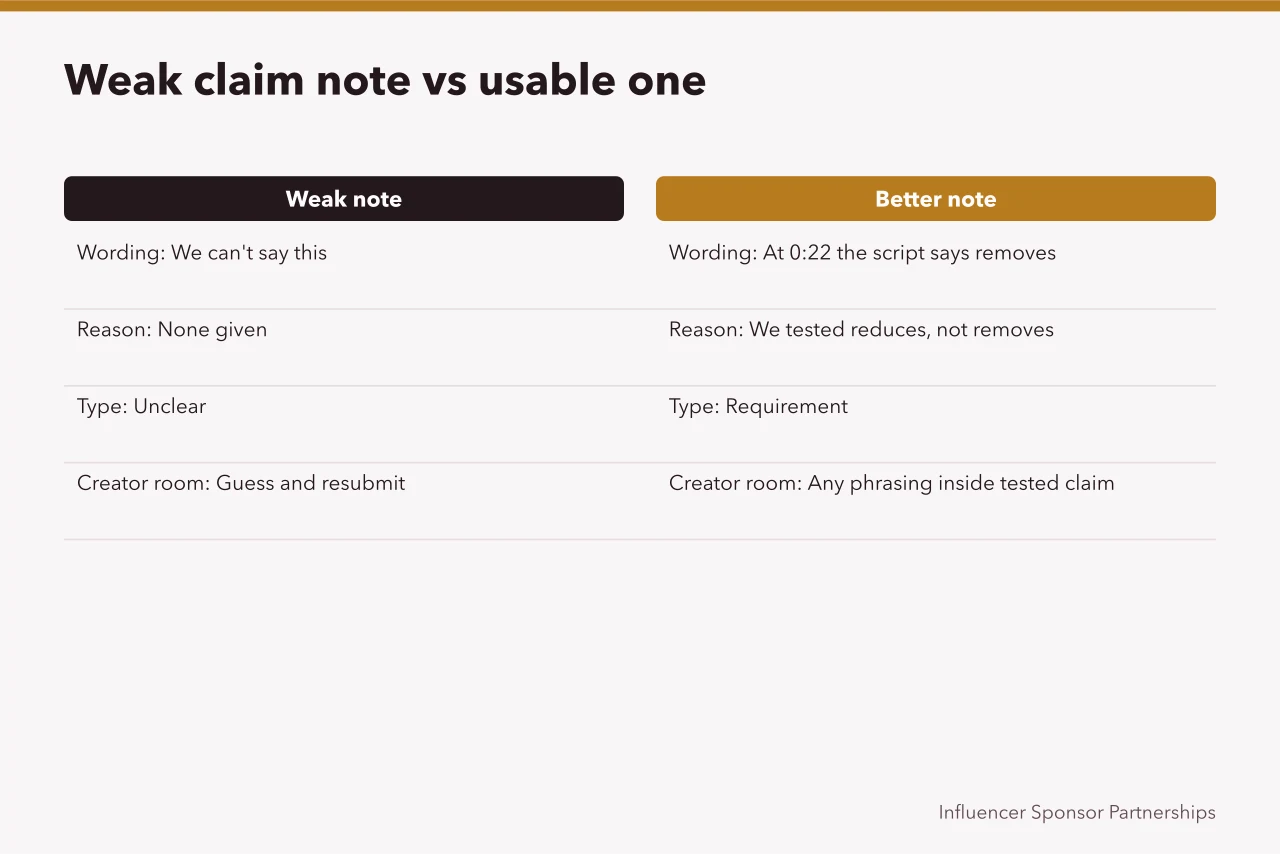
Better. "At 0:22 the script says the product removes the problem. We can support that it reduces it in the conditions we tested, not that it removes it. Requirement. Any phrasing that stays inside the tested claim works; we can send you the wording we use elsewhere."
Weak claim notes are expensive because the creator cannot tell whether the objection is to the verb, the whole sentence, or the idea. They guess, and the guess comes back wrong.
The underlying question is what a claim needs behind it. The distinction between a factual claim and obvious exaggeration is old enough to have a legal name: puffery. Where the line sits in practice is set out in the FTC's advertising FAQ for small business, and a lawyer is the right destination for anything consequential.
Disclosure notes
Weak. "Can you add the tag?"
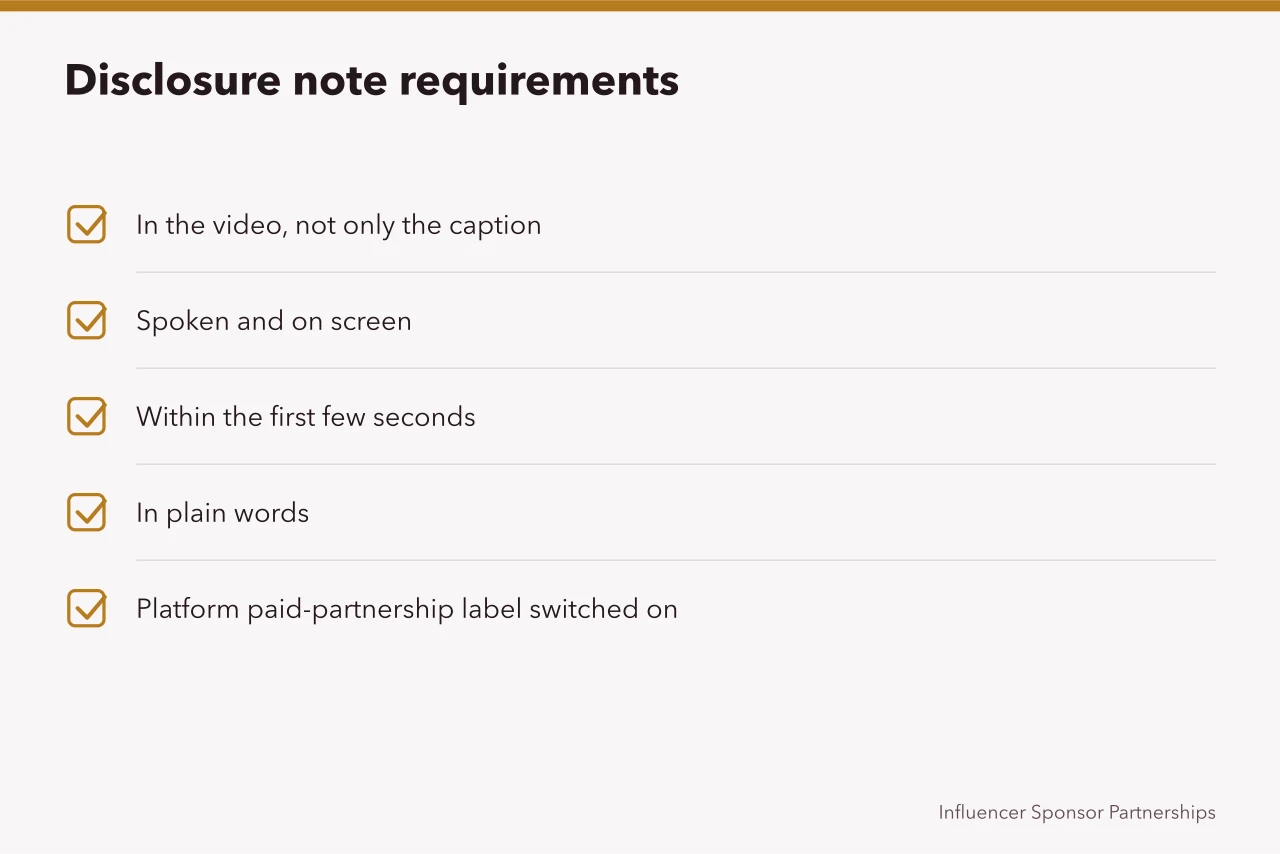
Better. "The disclosure is currently only in the caption, below the fold on a phone. It needs to be in the video: spoken and on screen, in the first few seconds, in plain words. Requirement, and it is a condition of acceptance. Also please switch on the platform's paid-partnership label."
Never. Any note asking for a disclosure to be shorter, later, less prominent, or blended into the content. This request is not a preference a reviewer is entitled to have, and it is the one note that should never leave your organization in any form.
Brand standard notes
Weak. "This doesn't feel like us."
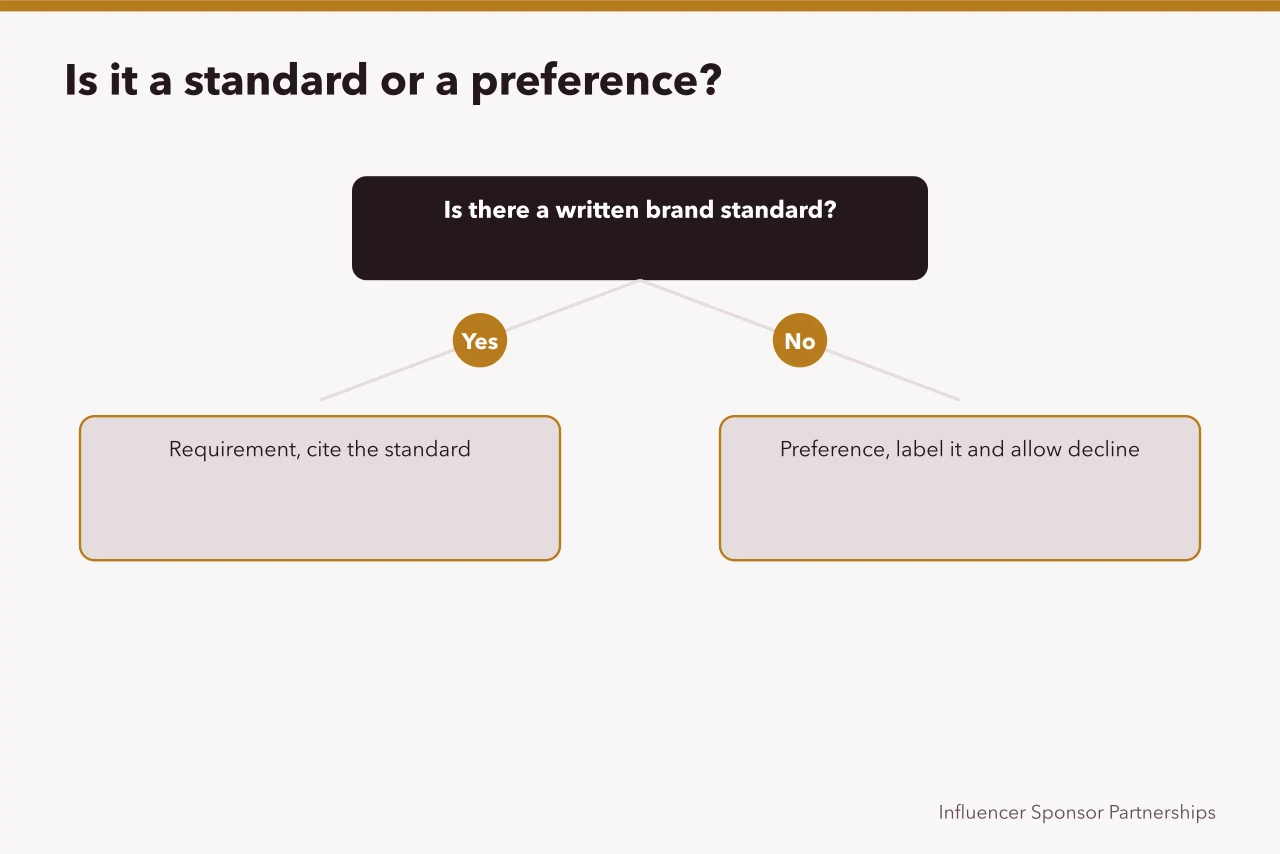
Better. "Our written standard says we do not use competitor names in comparisons. The line at 0:41 names one. Requirement, from the standard. The comparison itself is fine if the competitor is unnamed."
If there is no written standard, the note is a preference, and it should be labeled as one. The honest version is: "This is a preference rather than a rule; if it costs you the joke, keep the joke."
Taste notes
Weak. "Make it more energetic."
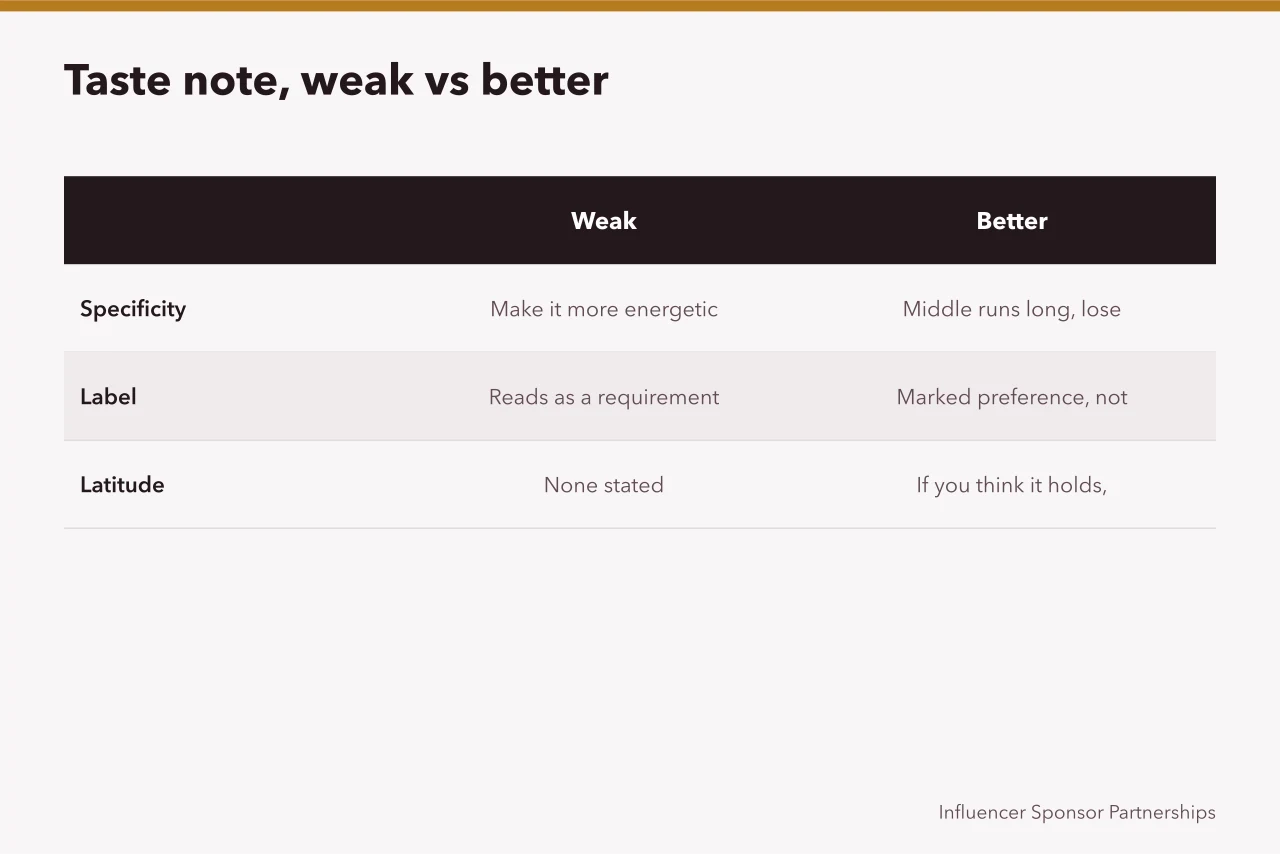
Better. "The middle section runs long and I lose the thread around 1:10. Preference, not a requirement. You know your audience's tolerance better than I do; if you think it holds, leave it."
Taste notes are legitimate and they should be rare, consolidated, and clearly marked. A creator who receives twenty preferences and three requirements in one undifferentiated list will treat all twenty-three as requirements and deliver something safe.
Notes that should not have been notes
| The note | What it actually is | Where it belonged |
|---|---|---|
| "Can we also get a vertical cut?" | A new deliverable | The scope conversation, and a fee |
| "Legal wants to see this again" | A missing decision right | The process design |
| "Marketing had a different idea" | Unresolved internal disagreement | Consolidated before sending |
| "Can we swap the music?" | A clearance problem discovered late | The brief, with cleared options supplied |
| "Please match the reference we sent" | A brief that was never written down | The brief |
The pattern is that most bad notes are symptoms of a decision that was not made earlier. That is what makes a review process feel slow when the reviewers are fast. The decisions belong in campaign briefs, and the priorities behind them in strategy and objectives.
A worked round, start to finish
The brand receives a first cut. Internally, four people comment. Two of the comments contradict each other. One is a claim issue, one is a disclosure issue, and three are preferences.
The wrong version: all seven comments are forwarded, unresolved, with a request for changes by Friday.
The right version: the owner reconciles them into one message. Two requirements, stated with reasons and sources. Three preferences, marked as preferences, with the note that any of them can be declined. The contradiction is settled internally before sending, and the person whose view lost is told why. One deadline, one reply address.
The second version takes an hour longer internally and saves two rounds. That trade is available on almost every campaign, and it is refused almost every time, usually because nobody owns the reconciliation.
What to check that notes cannot fix
Some things are checked, not reviewed. Whether third-party music, footage, locations and other people on camera are cleared for the intended use is a factual question with an answer somebody has to have.
Whether a brand name or logo appears in a way that creates a problem is another; the concept is trademark infringement, and the answer comes from counsel rather than a reviewer's instinct. The disclosure check happens on the published post, not the file, a point covered in contracts and disclosure.
Bottom line
Write every note with four parts: what, why, requirement or preference, and creator latitude, then consolidate all notes into one voice per round and settle internal contradictions before sending.
Keep requirements traceable to a rule or written standard. Mark everything else as a preference that can be declined, and never ask for a disclosure to be made less noticeable.
Common questions
Should preferences be sent at all?
Yes, if they are marked and if there are few of them. A reviewer who suppresses every preference ends up making one large late objection instead.
What if a creator declines a preference?
That is what marking it as a preference means. If you cannot accept a decline, it was a requirement and should have been labeled one.
How do you handle a note from someone senior who saw the work late?
Decide whether they have a decision right. If they do, the process needs them earlier. If they do not, someone has to say so, which is a management problem rather than a review problem.
Is timecoding notes worth the effort?
Yes. It is the single cheapest change available and it removes most of the ambiguity that causes repeat rounds.
Can a creator refuse a requirement?
They can refuse to make the change and decline the work. What they cannot do is publish material that carries a claim you have said is unsupportable, and what you cannot do is ask them to hide the commercial relationship.