
Rules
Influencer Sponsorship Contracts: What US Brands Must Put in Writing
How US brands should write influencer sponsorship contracts: deliverables, usage rights, exclusivity, disclosure checks, and termination clauses that hold up.
What to take away
- A clause earns its place only when it points at a decision two people can disagree about.
- Deliverables need counts, formats, platforms, and live dates, not adjectives.
- Usage rights need a term, a channel list, and a paid media allowance.
- Exclusivity should name a product category and a window, never a list of rival brands.
- The brand verifies disclosure, even though the creator publishes it.
Deliverables: Counts, Formats, and Live Dates
"Three posts about the product" cannot be enforced. Write "two TikTok videos, 20 to 45 seconds, live between June 1 and June 14, plus four Instagram Stories on launch day."
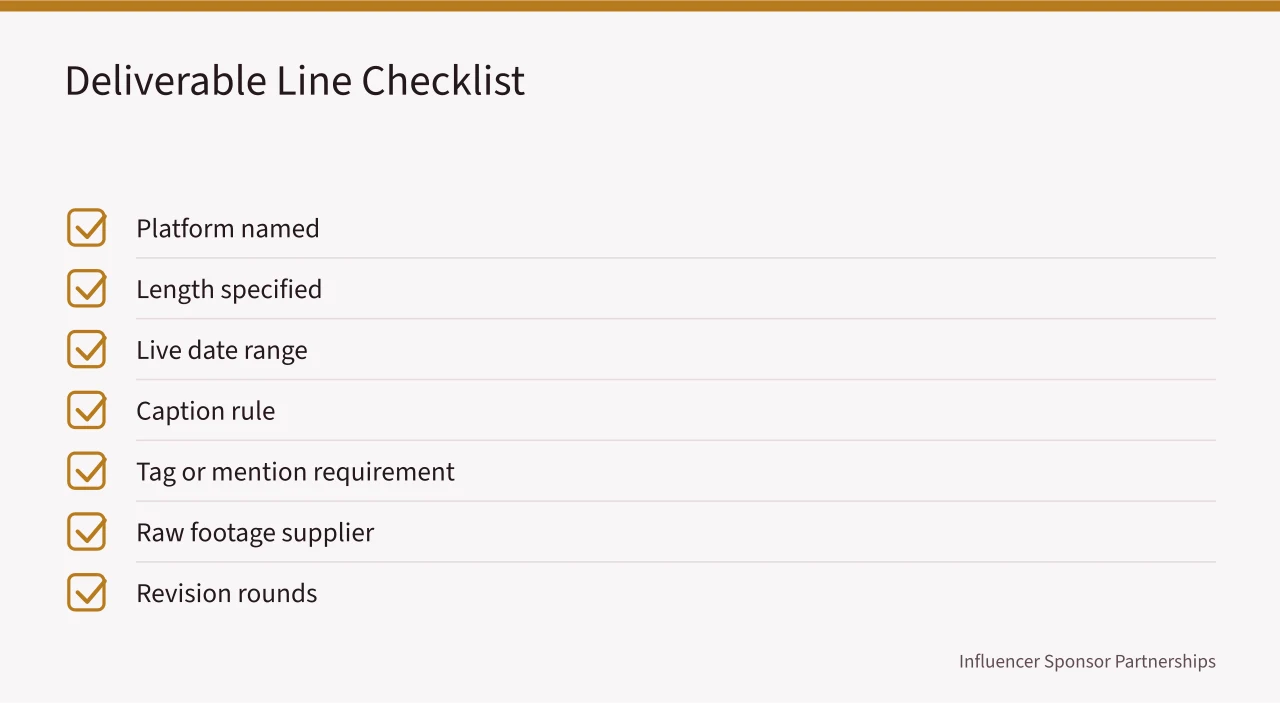
Two revision rounds is typical. Unlimited rounds is not a deliverable, it is an open-ended editing job.
Before any of that is drafted, someone has to decide what the sponsorship is for. Start with an arguable strategy objective so the contract has something to enforce beyond a post count.
Usage Rights: Term, Channels, and Paid Media
A grant of "perpetual, worldwide rights" reads generous until the creator's face appears on a billboard years later. Cap the term. Twelve months with a renewal fee is common.
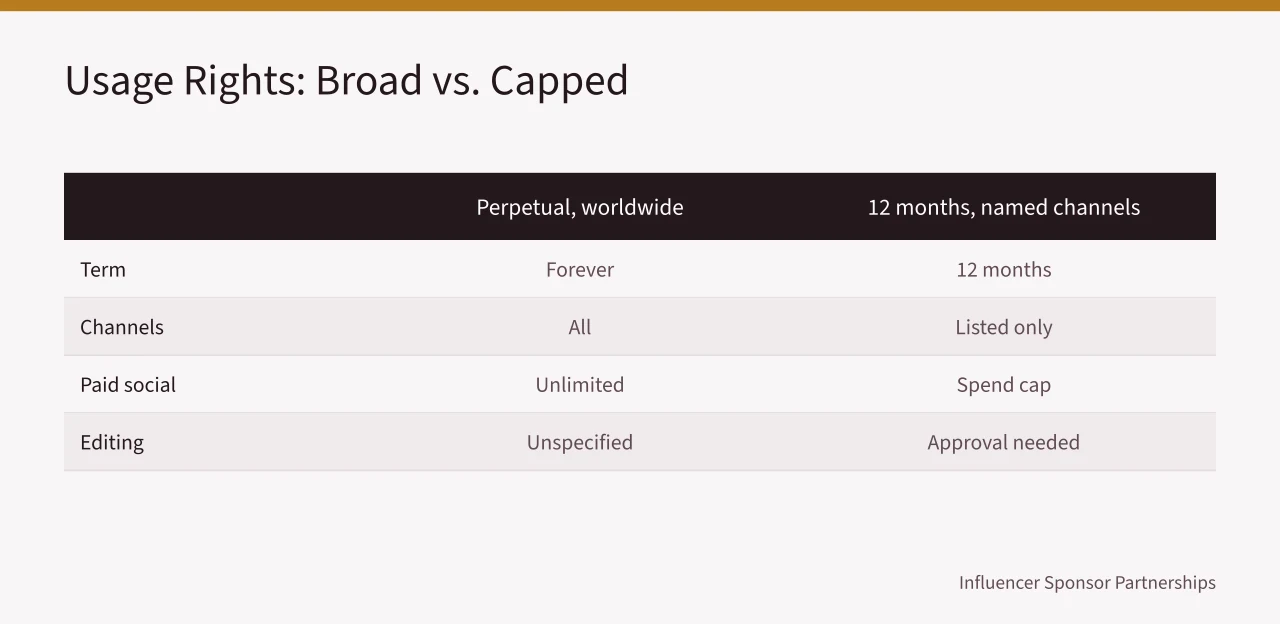
Then name the channels: organic social, brand website, email, retail display, paid social. Anything not listed is not licensed. Paid social is where budgets break, so add a spend cap or a separate fee tier.
Also spell out handle whitelisting and whether the brand may edit the creative. Editing that changes the claim can create a new advertising problem.
Exclusivity: Category First, Rivals Second
Listing competitor names ages badly, because new brands appear each quarter. Name the product category instead, then set the window, often 30 days before and 60 days after the campaign.
Define what counts as a competing promotion: paid posts, gifted posts, affiliate links, and ambassador programs. Then carve out deals the creator signed before the contract date, or the exclusivity clause can block the whole deal.
Disclosure: The Brand Verifies, the Creator Posts
The legal basis is Section 5 of the FTC Act (15 U.S.C. 45), which bars deceptive advertising. The FTC's Guides Concerning the Use of Endorsements and Testimonials in Advertising, codified at 16 CFR Part 255, say an endorser's material connection to the brand must be disclosed clearly and conspicuously. A material connection is any payment, free product, or other benefit that could affect how viewers weigh the endorsement. The FTC's .com Disclosures guidance covers effective screen disclosure.
The contract should name the disclosure text, its placement, and who checks the live post. Acceptable wording includes #ad, #sponsored or a plain sentence such as "Paid partnership with [brand]." Name the platform tool as well: Instagram's paid partnership label, YouTube's paid promotion checkbox, or TikTok's content disclosure toggle. Add that the creator keeps the post up for a set period and needs written approval to delete it.
Example: A Morality Clause That Survives a Scandal
Boilerplate morality clauses terminate on "conduct that harms the brand." That gives neither side a test. A workable version reads:
If the creator is charged with a felony, or publicly promotes a competing brand inside the exclusivity window, the brand may pause payment for undelivered assets and terminate within five business days of notice.
Both triggers are verifiable in public records. Private conduct is not, so leave it out, because the brand cannot prove it if the creator disputes it.
Termination Steps, Cure Periods, and Payment
Run terminations through a written sequence, not a phone call.
- The brand sends written notice naming the breached clause and the evidence.
- The creator gets five business days to cure, except for missed disclosure, which must be fixed the same day.
- If nothing changes, the brand terminates and pays only for assets already approved.
- If the brand cancels without cause, it pays a kill fee, often half of the remaining fee.
Then handle the money mechanics. Pay the creator as a contractor only if the relationship passes the test the IRS describes in its independent contractor classification guidance. Collect an IRS Form W-9 from the creator before the first payment. If payments reach the IRS reporting threshold for the year, the brand files Form 1099-NEC. Also set the invoice date, the approval window, and the late fee. One illustrative schedule is half the fee on signing and half within 30 days of final approval; terms differ from buyer to buyer.
Other Clauses a US Contract Needs
The commercial core leaves common disputes unanswered. Add these:
- Parties, effective date, and term:legal names, the start date, and the end date.
- Ownership of content:the creator keeps ownership and grants a license, or assigns ownership to the brand.
- Indemnification:each side covers claims caused by its own breach, and the creator covers claims over music or images the creator supplied.
- Confidentiality:fees and unreleased product details stay private.
- Governing law and venue:the state whose law applies and where a dispute is heard.
- Dispute resolution:negotiation first, then mediation or arbitration.
- Force majeure:excuses delay from events outside either party's control.
- Notices:an email address for each side.
Clause Wording: Weak Against Arguable
Weak wording
- Deliverables
- "regular posts"
- Usage rights
- "perpetual, worldwide"
- Exclusivity
- "no competitors"
- Termination
- "cause"
Arguable wording
- Deliverables
- "2 videos, dates fixed"
- Usage rights
- "12 months, paid social"
- Exclusivity
- "no alcohol brands, 90 days"
- Termination
- "felony charge, 5 day cure"