

Rules
What Are Canadian Influencer Disclosure Rules?
Canadian influencer disclosure rules run through the Competition Bureau, Ad Standards and Quebec's language law. A compliant post says who paid, early and clearly.
A worked example: one held post (illustrative)
Consider an illustrative case. An editor holds a Canadian creator's Instagram product post because its paid label sits after several hashtags and below the caption's visible cut. The task is to decide whether a viewer can recognize the commercial relationship, not to rewrite the product claim or assume a familiar tag is enough.
The creator has received payment for the post, so the connection itself is established. The editor follows the draft through four decisions: confirm the relationship, inspect the visible caption, request a correction, then save evidence of the version viewers actually encountered.
A Canadian campaign review supplies the broader setting, but this file turns on the placement of one paid Instagram caption. The product post is not a contest or advertised offer, so the editor keeps the review focused while noting that other campaign types may raise separate provincial considerations.
Step one: establish the relationship
The first check is the source of the claim and the creator's connection to the brand. Here, the agreement and brief identify payment for publication, so the reviewer records a paid relationship rather than treating the post as an unsolicited mention.
The editor compares the campaign terms with the draft and confirms that payment is tied to the post. The written campaign terms should make the deliverables and review process clear, but approval does not replace a disclosure that the audience can see. The reviewer also notes where the post will appear.
The Competition Act text addresses materially false or misleading representations made for a brand, while the Competition Bureau provides guidance about influencer marketing. Ad Standards also reviews complaints under the Canadian Code. Those routes inform the review without changing the immediate question: can viewers recognize the paid connection?
Step two: follow the viewer's path
The draft fails the visibility check because its disclosure appears after hashtags and below the caption's visible cut. A viewer may encounter the post without seeing the label. The issue is where the information appears, not whether the creator was paid or whether the label exists somewhere in the draft.
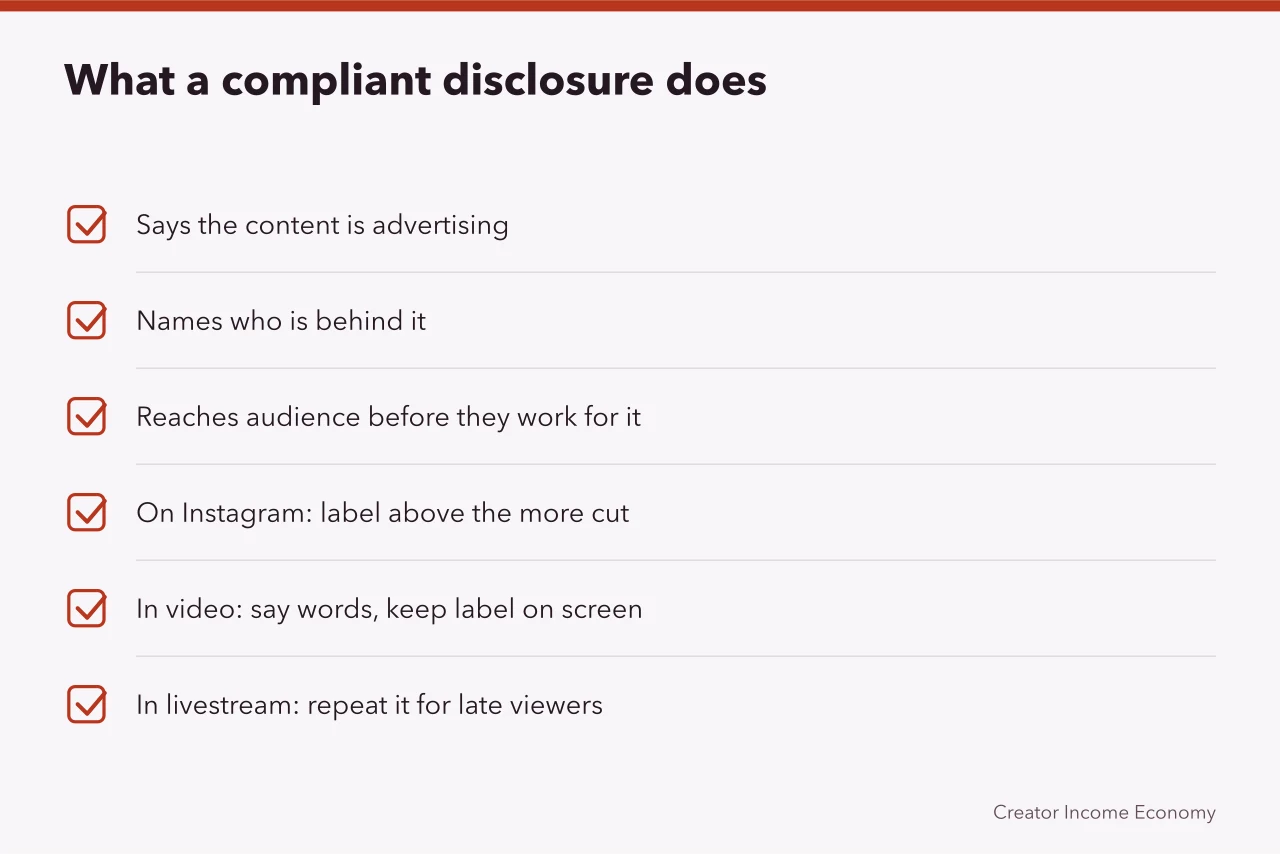
The editor asks the creator to move a plain, understandable label to the beginning of the visible caption and identify the brand. Clear campaign brief examples can make that instruction easier to follow, but the reviewer judges the finished post as it appears to the audience, not the wording of the brief alone.
The reviewer also considers the format. For a video, the creator should say the disclosure and keep a label on screen. A livestream disclosure should be repeated because viewers may join after the opening. A caption label that sits below the fold, or a spoken notice heard only at the start, may not reach the audience clearly.
Step three: return and verify the edit
The correction is specific: move the disclosure to the start of the visible caption and name the commercial connection and paying brand. The reviewer does not ask the creator to obscure the relationship or rely on viewers to search through hashtags for an explanation.
| Review point | Finding in the held draft | Required action |
|---|---|---|
| Relationship | Payment is tied to the post | Identify the paid connection |
| Placement | Label follows hashtags and is below the visible cut | Move it to the beginning of visible text |
| Brand identity | Brand is not identified in the requested label | Name the brand |
| Final check | Draft wording alone does not prove what viewers see | Review the revised post in its final position |
On resubmission, the editor checks the caption in the position where it will appear. The label must be easy to notice and understand there; its presence in an earlier version or approval thread does not resolve the original placement problem.
Disclosure and truthfulness remain separate checks. A visible label identifies the advertising relationship, but it does not make a materially false or misleading claim acceptable. The contract terms for sponsorships can clarify how supplied claims and requested revisions are handled. A US campaign map concerns a separate review and does not settle this Canadian one.
Step four: preserve the version that ran
After approval, the editor saves evidence that links the paid relationship to the published post. The file needs to show what the audience encountered, rather than only retaining an unposted draft or a note saying the caption was approved.
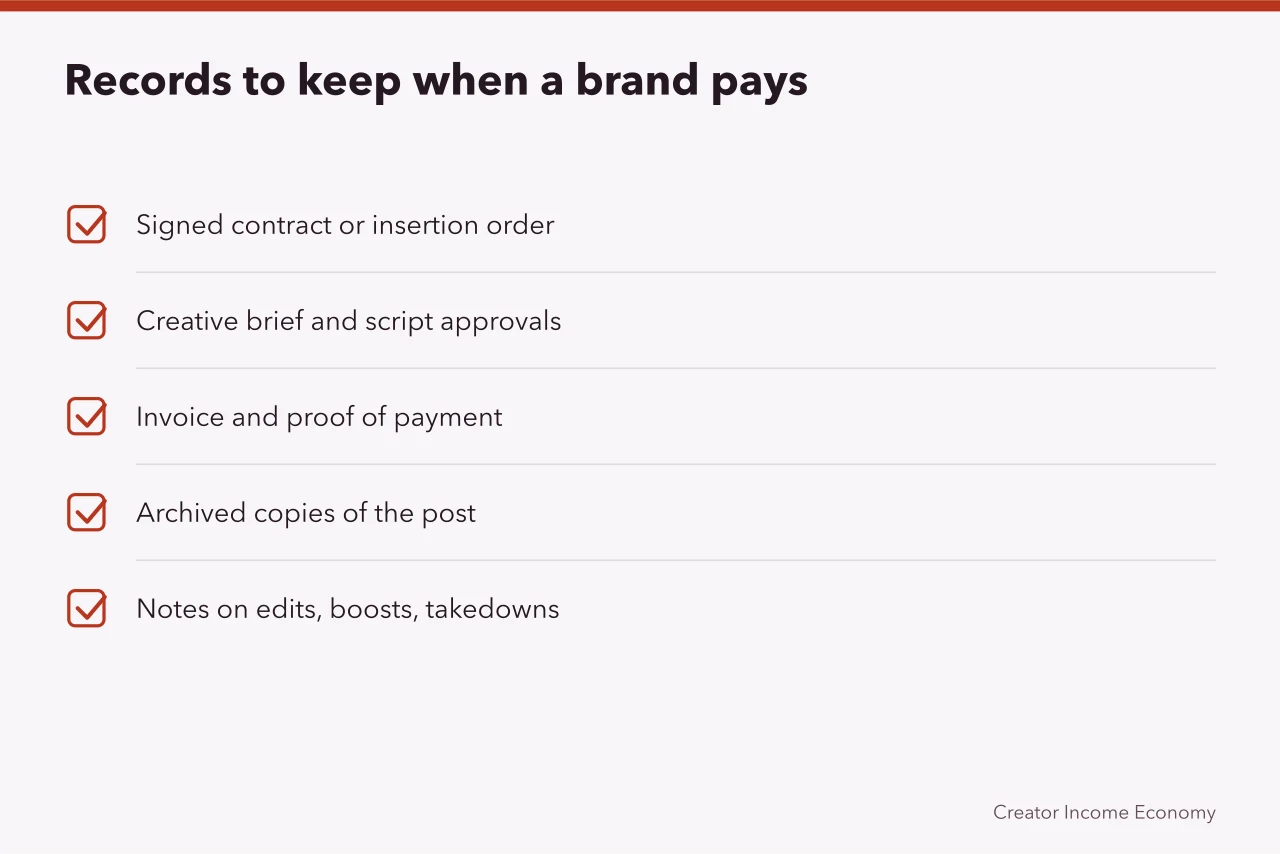
The editor keeps the signed agreement, brief, approvals, invoice, proof of payment, and an archived copy of the published post with its disclosure visible. The Canada Revenue Agency expects business records to be kept for six years from the end of the last tax year they concern, a duty found in subsection 230(4) of the Income Tax Act. Edits, paid boosts, and takedowns stay with the campaign evidence so later changes can be understood.
- Signed contract or insertion order listing deliverables
- Creative brief, script approvals, and emails that changed a claim
- Invoice and proof of payment
- Archived copy of the post with the disclosure visible
- Notes on edits, paid boosts, and takedowns
Avoiding the content approval mistakes can help catch version changes before publication, but the archived post remains evidence of what ran. If payment comes from links rather than a fixed contract fee, the payment terms are also relevant to understanding the creator's commercial connection.
The named rules behind the decision
A reader who needs to cite the rules should check these sources.
- Competition Act (R.S.C. 1985, c. C-34):section 52 covers knowingly or recklessly false or misleading representations, and section 74.01(1)(a) covers the civil case of materially false or misleading representations. Section 52(4) directs the reviewer to the general impression a representation gives, as well as its literal meaning.
- Competition Bureau:the enforcer of the Act, which publishes guidance telling influencers and brands that a paid connection must be disclosed clearly and prominently.
- Ad Standards:the self-regulatory body that administers the Canadian Code of Advertising Standards (Clause 7 covers testimonials) and publishes the Influencer Marketing Disclosure Guidelines, covered in the next section.
- Quebec:the Charter of the French Language, often called Bill 101, governs the language of commercial advertising aimed at Quebec audiences, covered below.
- Provincial consumer protection statutes:examples include Ontario's Consumer Protection Act, 2002 and British Columbia's Business Practices and Consumer Protection Act. Contests also fall under section 74.06 of the Competition Act.
What the Ad Standards Influencer Marketing Disclosure Guidelines require
The guidelines build on Clause 7 of the Code and its Interpretation Guideline #5: any material connection between an influencer and the brand must be disclosed. A connection covers payment, free products, discounts, affiliate commissions, and family or employment ties.
In practice, the guidelines ask for four things. The disclosure must be clear and prominent, sit in the post itself rather than only in a profile or a comment, be visible without tapping to expand, and use plain terms. The label #Ad, on its own, is the clearest choice; ambiguous tags such as #sp or #collab may not be understood.
Ad Standards reviews complaints under the Code, publishes its decisions, and names the advertiser. Both the brand and the influencer are expected to know the guidelines. Platform labels such as Instagram's paid partnership tag can help, but the current guidelines ask whether the label is prominent and clear, so check the latest wording on adstandards.ca.
What Quebec language rules require of an ad aimed at Quebec
The Charter of the French Language requires commercial advertising to be in French. Since 1 June 2025, other languages may appear alongside it only if the French is markedly predominant, meaning it has a much greater visual impact than the other text.
The Office québécois de la langue française treats websites and social media as commercial publications. A brand running a paid post for Quebec viewers should therefore plan a French caption and French disclosure, not an English post with a translated tag. The creator and the brand should agree in the contract who writes and approves the French version.
Practical rules to take away
The example points to a practical test: explain the commercial connection in plain language, place the disclosure where viewers notice it promptly, and retain evidence of the final version.
These steps address disclosure; they do not replace review of the claim itself or other rules that may apply to a particular campaign.
A product sent with an expectation of coverage creates a connection to disclose. An unsolicited gift without that expectation is a judgment call, so disclosure is safer when the relationship is unclear. A label such as #sponsored can work when it is clear, early, and not buried among unrelated hashtags.
Check the label in the final placement rather than approving its wording in isolation. A campaign that runs in Quebec may need a separate Quebec language review. Provincial consumer protection statutes can also add conditions for contests and advertised offers, so this product-post example should not be treated as a universal answer to those cases.
Approval does not remove the possibility of consequences. Ad Standards publishes decisions and identifies the advertiser. The Competition Bureau may seek a court order to stop a claim and require a corrective notice, or resolve a matter through a consent agreement with binding terms. Since 20 June 2025, private parties have also been able to ask the Competition Tribunal for leave to bring a deceptive marketing case, which it grants only where that is in the public interest. The Competition Act can reach any person who makes the representation, including a creator who published it.