Features
Part of Getting content approvals right the first time
Spotting content approvals mistakes before they cost money
Content approvals mistakes, sorted by the stage they happen at: brief, concept, first cut, final, and the ones that only appear after publication.
Approval mistakes are cheap early and expensive late, and almost all of them are made early and discovered late. Sorting them by stage is useful because the stage tells you who could have prevented it and what would have to change.
The design of the process itself is in content approvals. This page is about the specific things that go wrong inside it.
What to take away
- The cost of a change rises steeply with production stage, so a review that only starts at the first cut has already lost most of its value.
- Reviewing the file and never the published post is the mistake that produces the problems people actually get asked about.
- Every unresolved internal disagreement that reaches a creator becomes their problem, and they cannot solve it.
Before anything is made
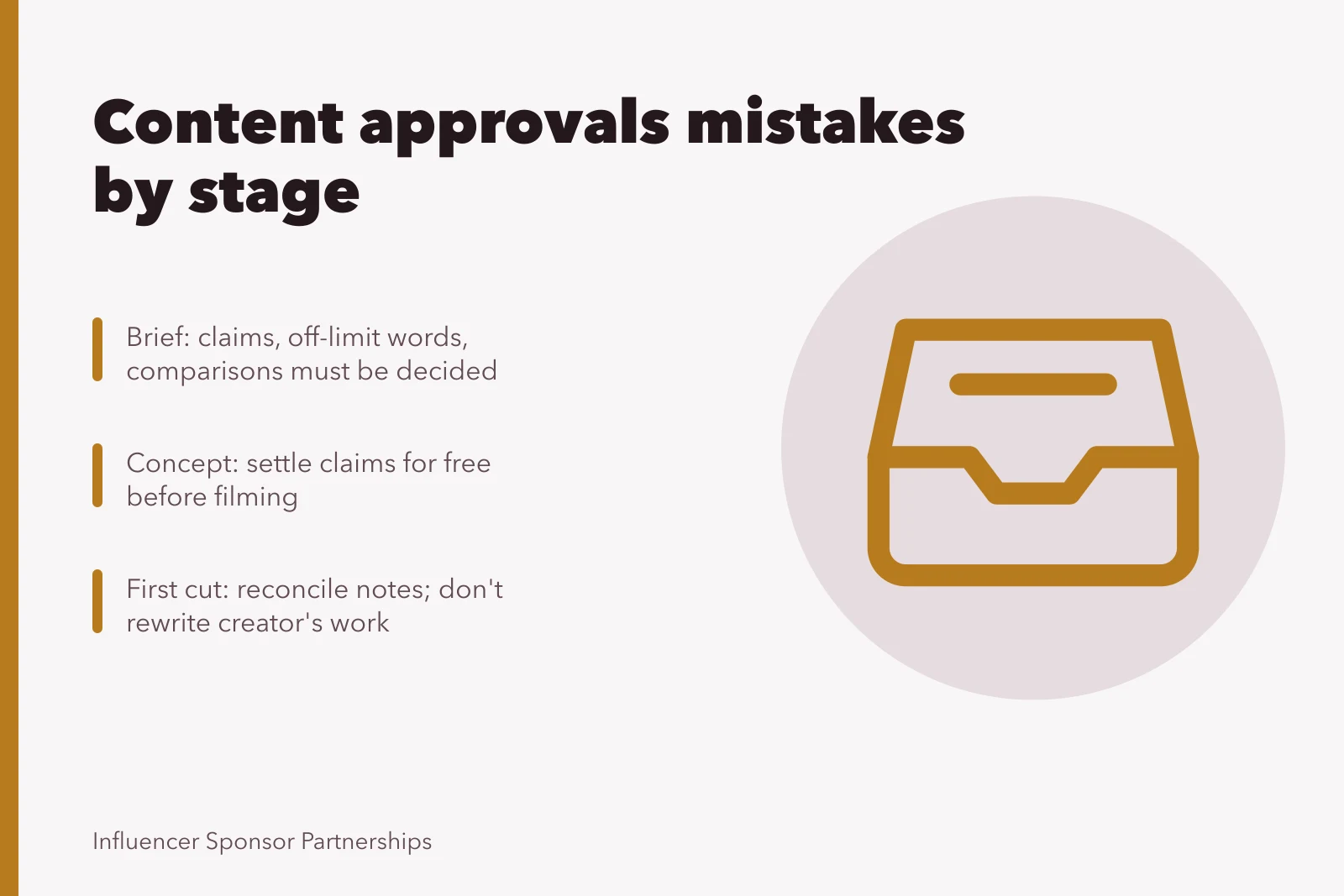
Nobody decided what could not be said. The claims a product can support, the words that are off limits, and the comparisons that are not allowed are all knowable in advance. Leaving them to be discovered at the first cut converts a briefing question into a rewrite.
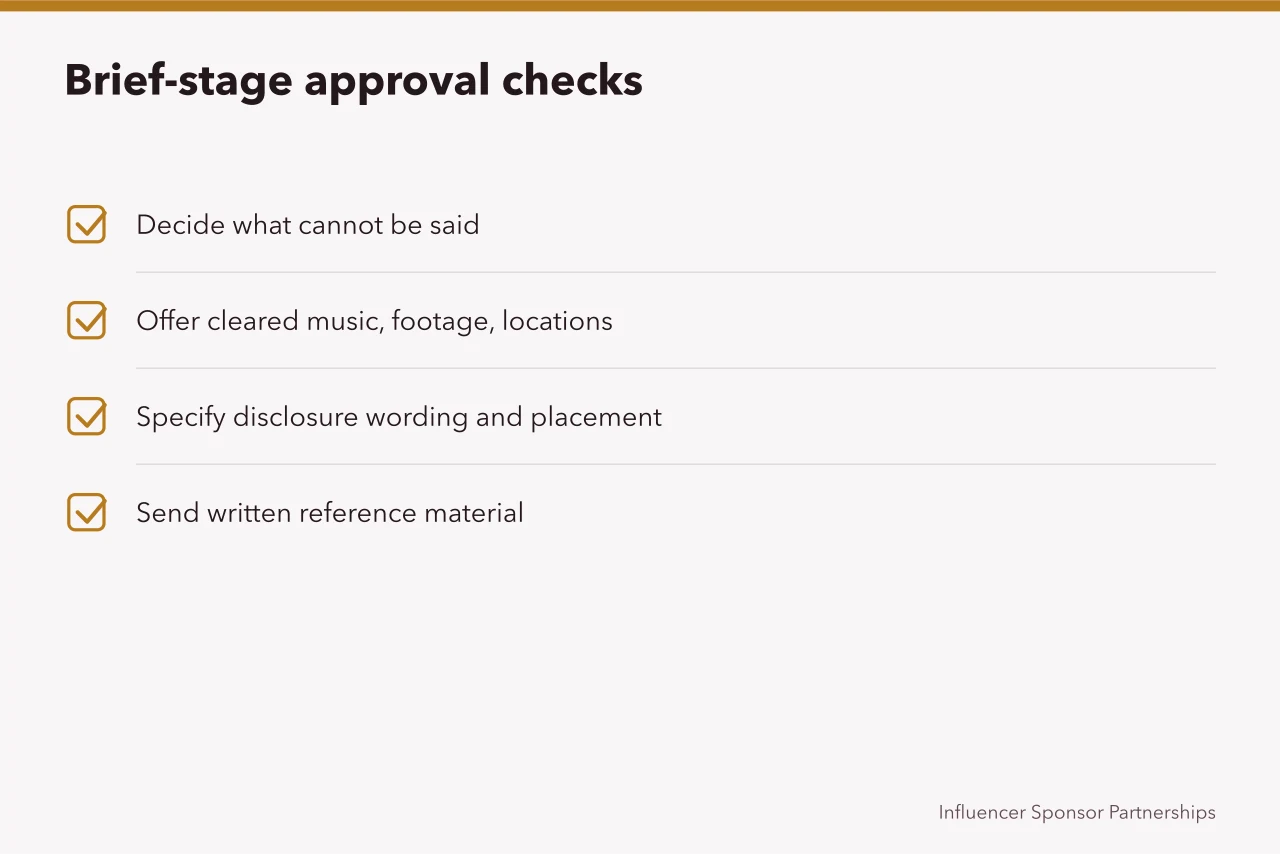
No cleared music, footage or locations were offered. Platform audio libraries are generally licensed for use on that platform, not for advertising. Supplying cleared options up front costs less than replacing a soundtrack in a finished edit.
The disclosure requirement was left as a contractual sentence. A clause creates an obligation. It does not tell a creator where the disclosure goes or in what words, and it does not check that it happened.
The reference material was never sent. Reviewers frequently have an image in mind that nobody has written down, and the first cut is where it appears, as a note that begins "we were thinking more like".
All four of these belong in campaign briefs, and every one of them costs an extra round when it is missing.
At concept and script
Skipping this stage entirely. Reviewing only the finished asset is the most common and most expensive design fault. A script change is a conversation; the same change after filming is a shoot.
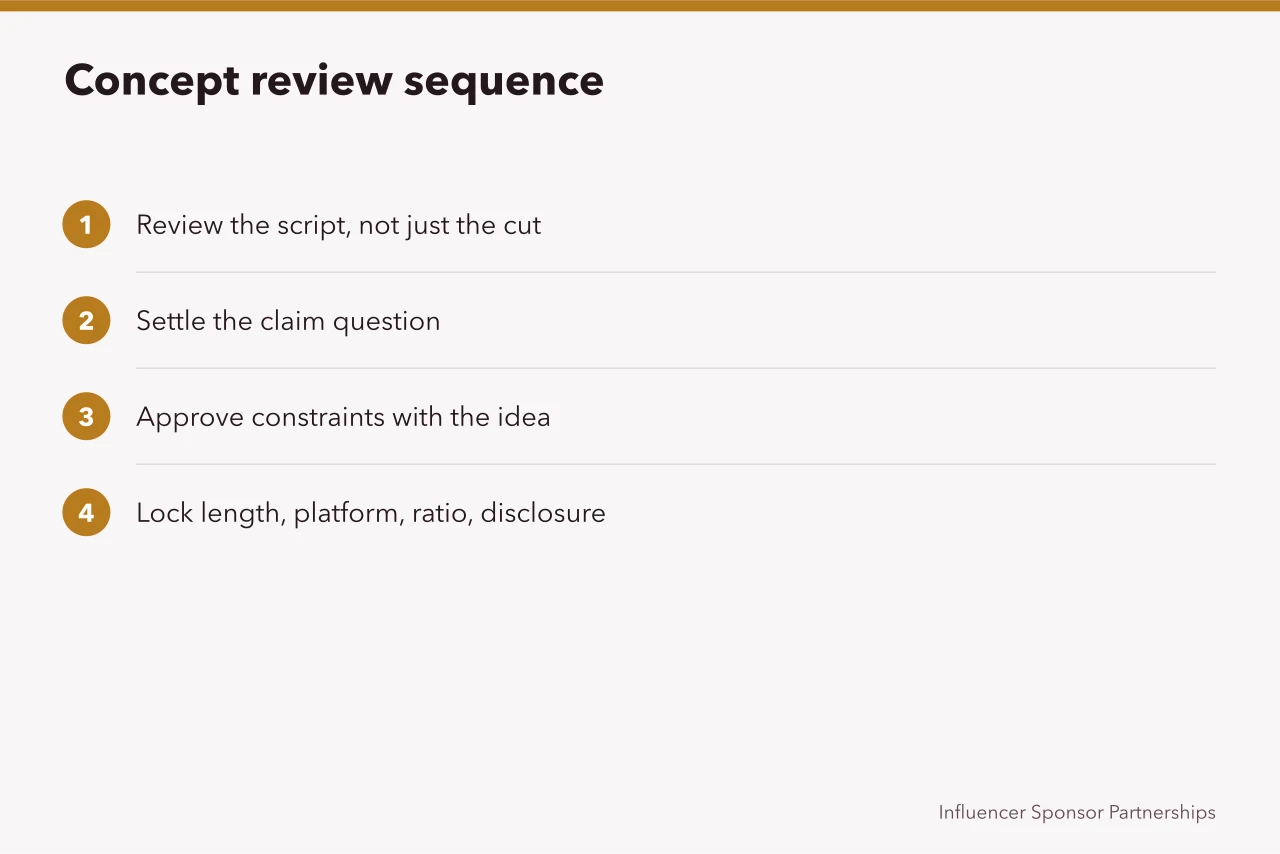
Reviewing for taste and ignoring substance. Concept review is where the claim question should be settled, because it is the last point at which a claim can be changed for free. What a claim needs behind it is a real question with a real answer, and the FTC's advertising FAQ for small business is a plainer starting point than most internal documents.
Approving a concept without approving its constraints. Saying yes to an idea while leaving the length, the platform, the aspect ratio and the disclosure placement open means you have approved almost nothing.
At the first cut
Sending unreconciled notes. Four people comment, two contradict each other, and all of it is forwarded. The creator now has to arbitrate a disagreement inside your organization, which they cannot do and should not be asked to.
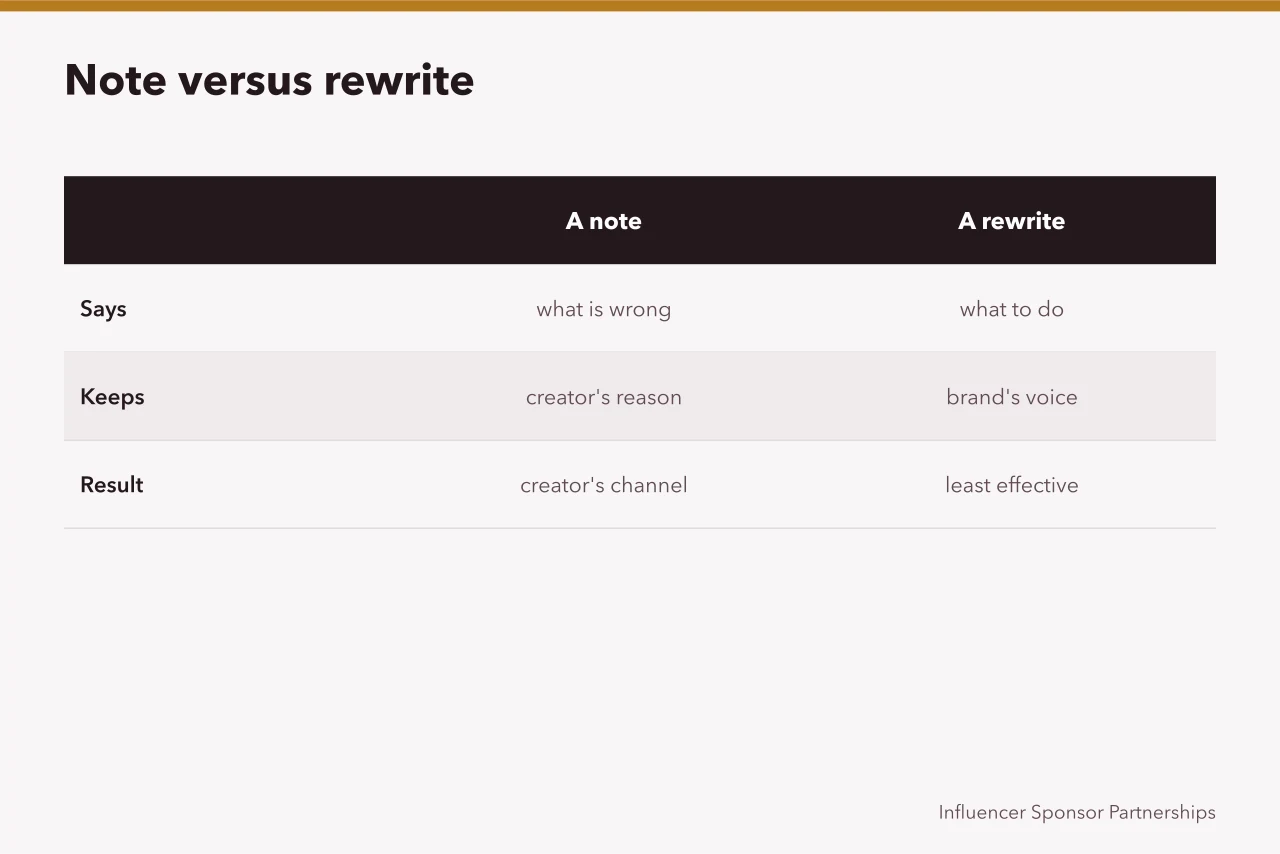
Rewriting rather than noting. A note says what is wrong and why; a rewrite says what to do. Rewrites remove the reason the creator was hired, and they produce work in the brand's voice on the creator's channel, which is the least effective combination available.
Treating preferences as requirements. If everything is a requirement, nothing can be declined, and you get the safe version. Mark them.
Arguing about the wrong things. Review time reliably drains into whatever is easiest to have an opinion about: a word choice, a color, a thumbnail. The phenomenon is well known enough to have a name, the law of triviality, and the defense is an agenda: claims and disclosure first, everything else after.
Missing the response deadline you never committed to. If the contract binds the creator to a turnaround and leaves your response time open, the schedule is being paid for by them.
At final approval
A senior stakeholder sees the work for the first time. This is a process failure, not a reviewer failure. Either they have a decision right and belong at concept, or they do not and should be informed rather than consulted.
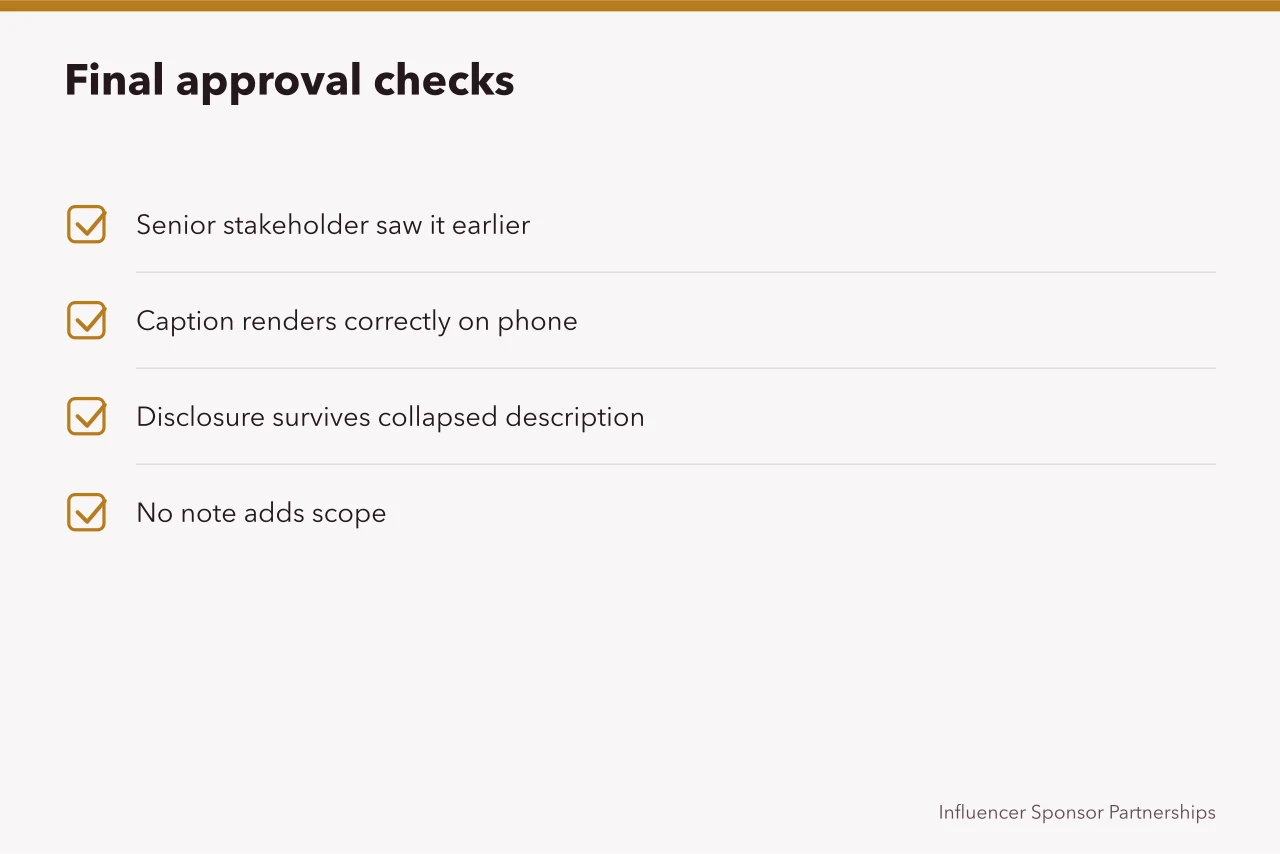
Approving the file and not the context. How the caption renders on a phone, where the fold falls, whether the disclosure survives with the description collapsed: none of these are visible in the asset.
Letting a note add scope. An extra cut, a second aspect ratio, an additional platform. Each is a purchase. Raising it as a revision is how approval processes become expensive without anyone deciding they should, and the general pattern is ordinary scope creep.
After publication
| The mistake | What it costs | The fix |
|---|---|---|
| Nobody looked at the live post | The disclosure problem you will be asked about | A named checker, a date, a phone |
| No capture of how it appeared | Nothing to show later | A dated screen capture beside the contract |
| Content reused without re-checking | Labels stripped by the format change | Re-check on every reuse |
| Asking for a change after publication | A visible edit and a worse relationship | Decide before, not after |
| Requesting a takedown for taste | An avoidable public problem | Reserve removal for defined causes |
The last row is worth stating plainly. A takedown request that is not grounded in a defined cause tends to attract more attention than the thing it was meant to suppress, which is common enough to have its own name, the Streisand effect. What the contract should actually say about removal is covered in contracts and disclosure.
The mistake underneath the others
Approvals get blamed for problems created upstream, but when a review takes six rounds, the usual cause is not slow reviewers. Nobody decided what the campaign was for, what it could claim, and who had the right to say yes.
The review is the first moment that absence becomes visible, and that decision belongs in strategy and objectives.
Bottom line
Settle claims, clearances and disclosure placement before anything is made. Review the concept, not just the cut. Consolidate notes into one voice, mark preferences as preferences, and commit to your own response deadline. Then check the published post, capture it, and re-check whenever the content is reused.
Common questions
How many rounds should a review take?
Two, when the brief did its job. Consistently more than that is a brief problem or a decision-rights problem, not a reviewer problem.
Is it ever right to rewrite a creator's script?
To fix a claim or a disclosure, yes, and say why. To improve the writing, no: you are paying for their voice.
What if a stakeholder keeps appearing at the last minute?
Give them a slot at concept stage and hold them to it. If that fails, someone senior has to decide whether they hold a decision right, because the current arrangement is that they do without being accountable for the delay.
Who should own the published-post check?
One named person, with the date recorded. Shared responsibility for this check reliably means nobody does it.
Can approvals be skipped for small collaborations?
The taste review can be light. The claim and disclosure checks cannot, because the exposure does not scale down with the fee.