Industry
Part of A campaign brief works as a constraint, not a choreography sheet
Campaign briefs mistakes: what goes wrong and why
Campaign briefs mistakes: unstated mandatories, taste dressed as a requirement, claims nobody decided, and the costs that only appear on the invoice.
Almost every argument during approvals is a brief defect with a delay built into it. Something was left unsaid, or said as a preference, and the disagreement waited until the work existed and was expensive to change.
That makes the argument itself a useful diagnostic. This page works backwards from the fights that actually happen to the lines that caused them, because the fix is nearly always a sentence you could have written for free three weeks earlier.
What to take away
- If you find yourself giving feedback you cannot point at the brief to justify, the brief was the problem.
- The most damaging brief mistakes are omissions, and omissions are invisible until the work arrives.
- A mandatory introduced after production is not feedback; it is a change of scope, and it should be treated as one.
Read the argument backwards
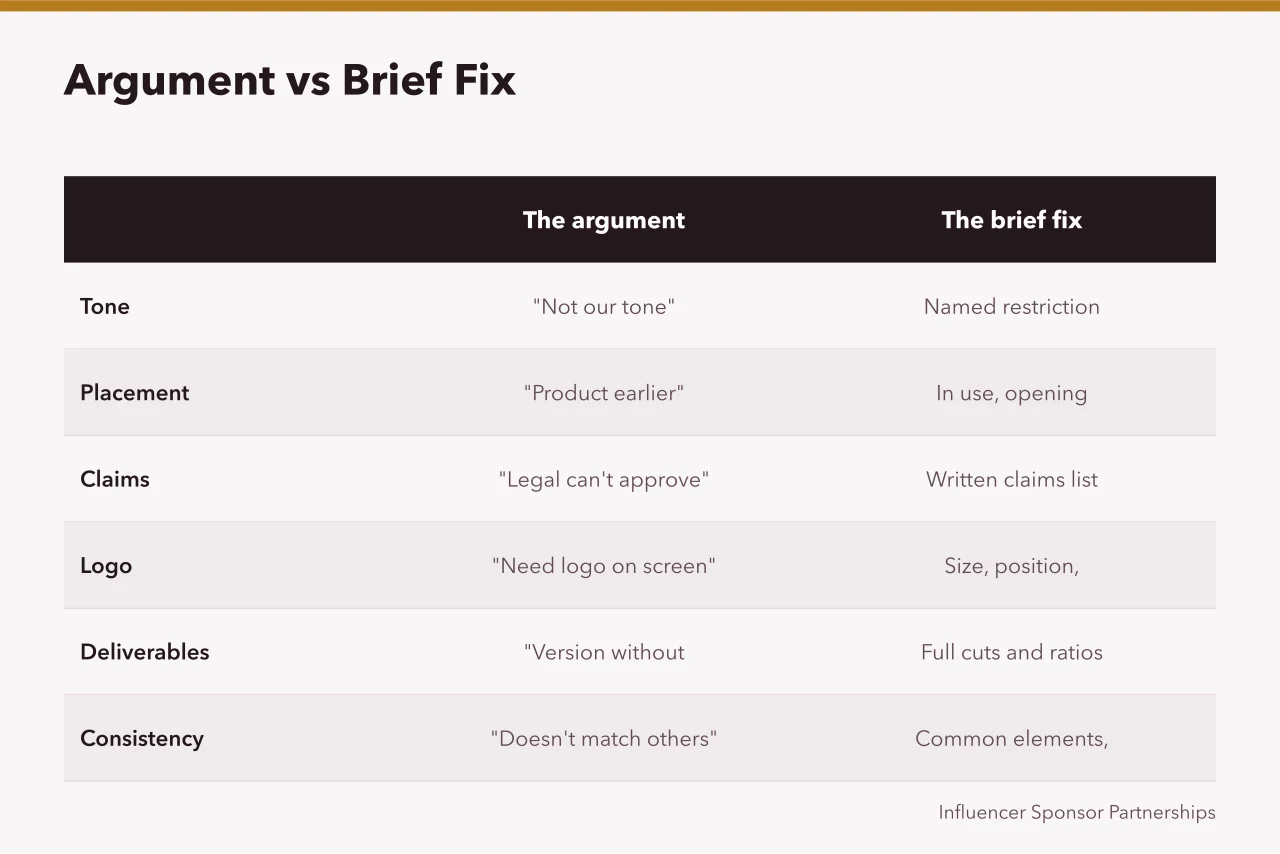
| The argument you are having | The brief mistake behind it | What the brief should have said |
|---|---|---|
| "This is not really our tone" | Tone was described with adjectives rather than bounded | Either nothing, or a named restriction the creator can act on |
| "The product needs to appear earlier" | Placement was never specified because it felt obvious | The product appears within the opening section, in use |
| "Legal cannot approve this claim" | The claims policy was not written before the brief went out | These claims may be made, these may not, in any wording |
| "We need the logo on screen" | An assumed mandatory that lived in someone's head | The logo appears on screen, at this size, in this position, for this long |
| "Can we get a version without the music?" | Deliverables were listed as one item when three were needed | The full list of cuts, ratios and stripped versions, in the original scope |
| "This does not match the other creators' posts" | Consistency was expected but never briefed as a constraint | The common elements every partner must include, stated identically to each |
| "The disclosure is too prominent" | Someone believed disclosure was a matter of taste | It is a requirement, stated plainly, and not subject to review preference |
The pattern in the right-hand column is that every fix is shorter than the argument it prevents. That is generally true of brief defects, and it is why briefs get worse rather than better over time: the corrections get added as feedback rather than as lines.
The unstated mandatory
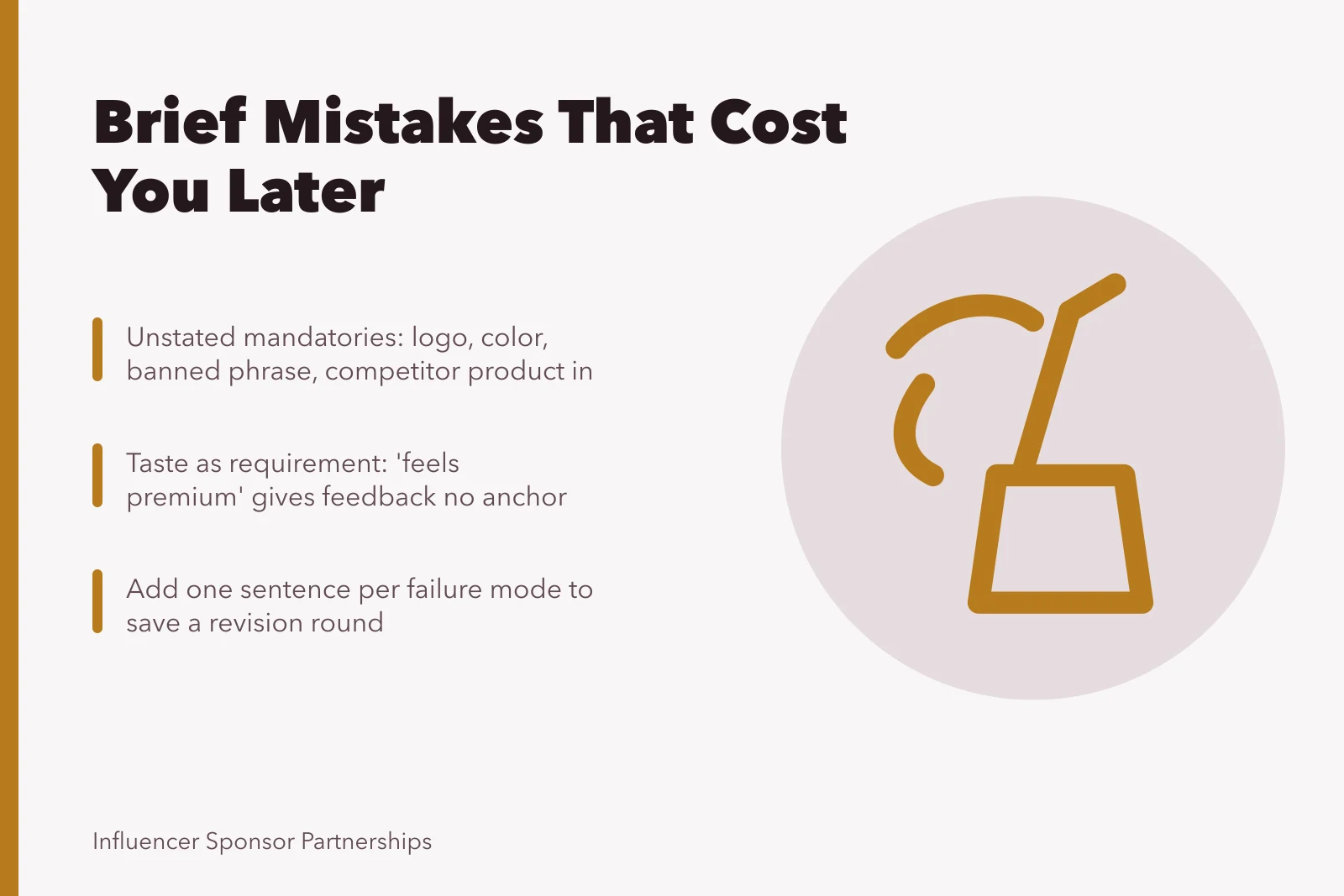
The most common defect is a requirement that everyone in the brand assumes and nobody wrote down. A logo. A color. A phrase that must never be used. A competitor product that must not appear in shot.
It is invisible because it is obvious internally. The test is to ask someone outside the team to list the campaign's non-negotiables from the brief alone. Anything they miss is an unstated mandatory, and it will appear as a change request after the shoot.
Late mandatories are the ones that damage relationships. Introducing a requirement after production means asking for unpaid rework, and the correct handling is to name it as a change of scope rather than to present it as a correction. What that means commercially belongs in rates and negotiation.
Taste presented as a requirement
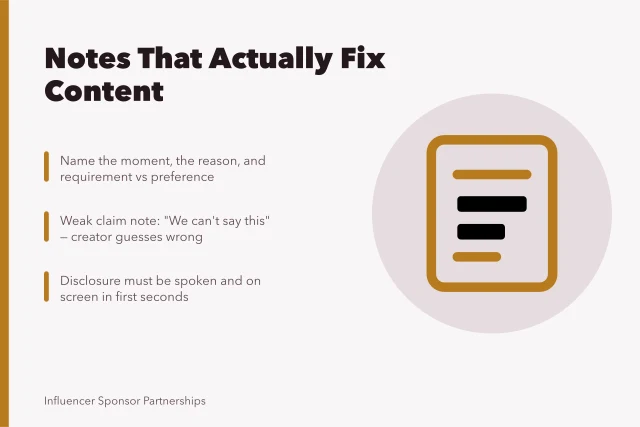
A brief that says "we like content that feels premium" has committed the brand to nothing and the creator to guessing. When the work arrives and it does not feel premium to a particular reviewer, the feedback has no anchor, and the argument becomes personal because there is nothing else to appeal to.
The fix is to either name the observable things that produce the feeling for you, or accept that this is the creator's judgment and stop reviewing it. Deciding which of those applies is a control question, and the ledger for it is in campaign briefs strategy.
No example of what is wrong
Most briefs include references for what is wanted. Very few include an example of what would be unacceptable, which is the more informative half.
You do not need to name anyone else's work. Describing the failure is enough: content where the product appears without being used, a piece where the offer is mentioned only in the caption, an edit that removes the part where the thing is actually demonstrated. One sentence per failure mode saves a round of revisions.
Claims that were never decided
A brief that asks a creator to say the product is the best in its category has moved a decision the brand should have made onto someone who cannot make it.
Worse is a brief that asks a creator to describe an experience they have not had, or to present an opinion they do not hold as their own. That is a content honesty problem, not a wording problem.
Expectations for endorsements and testimonials are in the current FTC guidance on consumer reviews and testimonials. Check that reference rather than an internal habit.
Decide what may be claimed before the brief is written, get it agreed by whoever will have to defend it, and put the list in the brief. Doing this after the work exists produces the most expensive category of rework.
The brief that arrives after the booking
A brief that lands once the shoot is scheduled is not a brief. It is a set of corrections issued in advance, and the creator will read it that way.
This usually happens because briefing is treated as a task, not a dependency. The fix is scheduling: the brief gets a date. That date sits before the production date by a real margin, and if it slips, production slips too.
Teams that reject that second half will keep producing late briefs indefinitely.
The stakeholder who appears at the end
Someone with veto power sees the work for the first time at approval, disagrees with a decision that was settled weeks earlier, and the whole thing reopens.
This is a brief mistake because the brief is where that person should have been. If a stakeholder can reject finished work, they must review and sign the brief. If they will not do that, someone senior has to decide whether their veto is real. Running the review so this does not happen is covered in content approvals.
Mistakes that only surface in the invoice
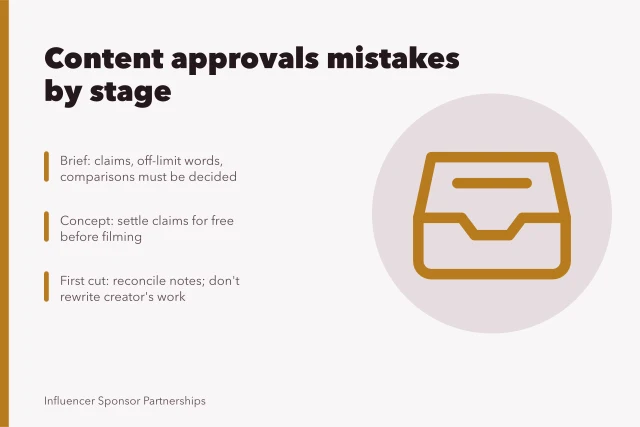
Deliverables described loosely. "Social content" is not a scope. Every cut, ratio, stripped version and still is work, and each one that was not listed is either unpaid rework or an argument.
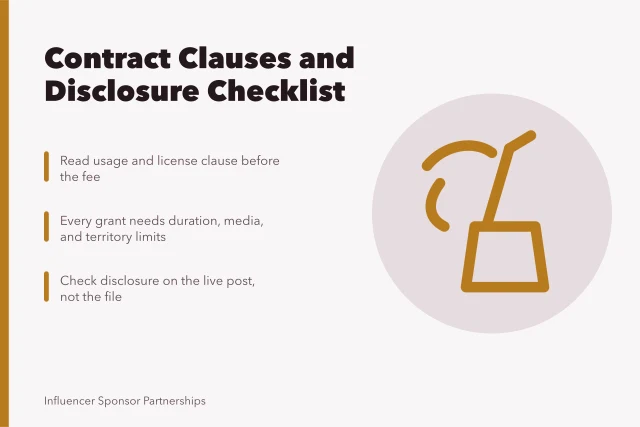
Usage implied rather than stated. A brief that mentions running the content in advertising, alongside a contract that licenses only the post, is a conflict that surfaces when the paid media team schedules it. Keep the terms in the agreement and reference them, as contracts and disclosure sets out.
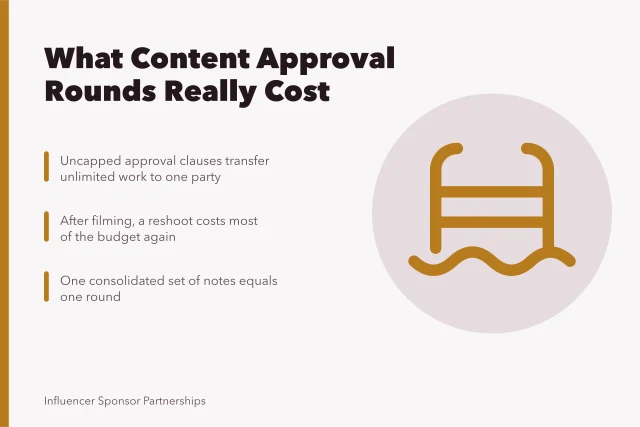
Revision rounds unbounded. If the brief does not say how many rounds are included, the answer will be however many the brand wants, and the creator will price the next campaign accordingly.
A related failure is briefing a claim that nobody has checked can be supported. What a claim needs behind it is a real question with a real answer, and the FTC's advertising FAQ for small business is plainer on it than most internal guidance.
A pre-send check
Read the draft and ask three questions of every paragraph. Could a competent creator ignore this line and still satisfy the brief? Could I give feedback against it if they did? Would the campaign be worse without it?
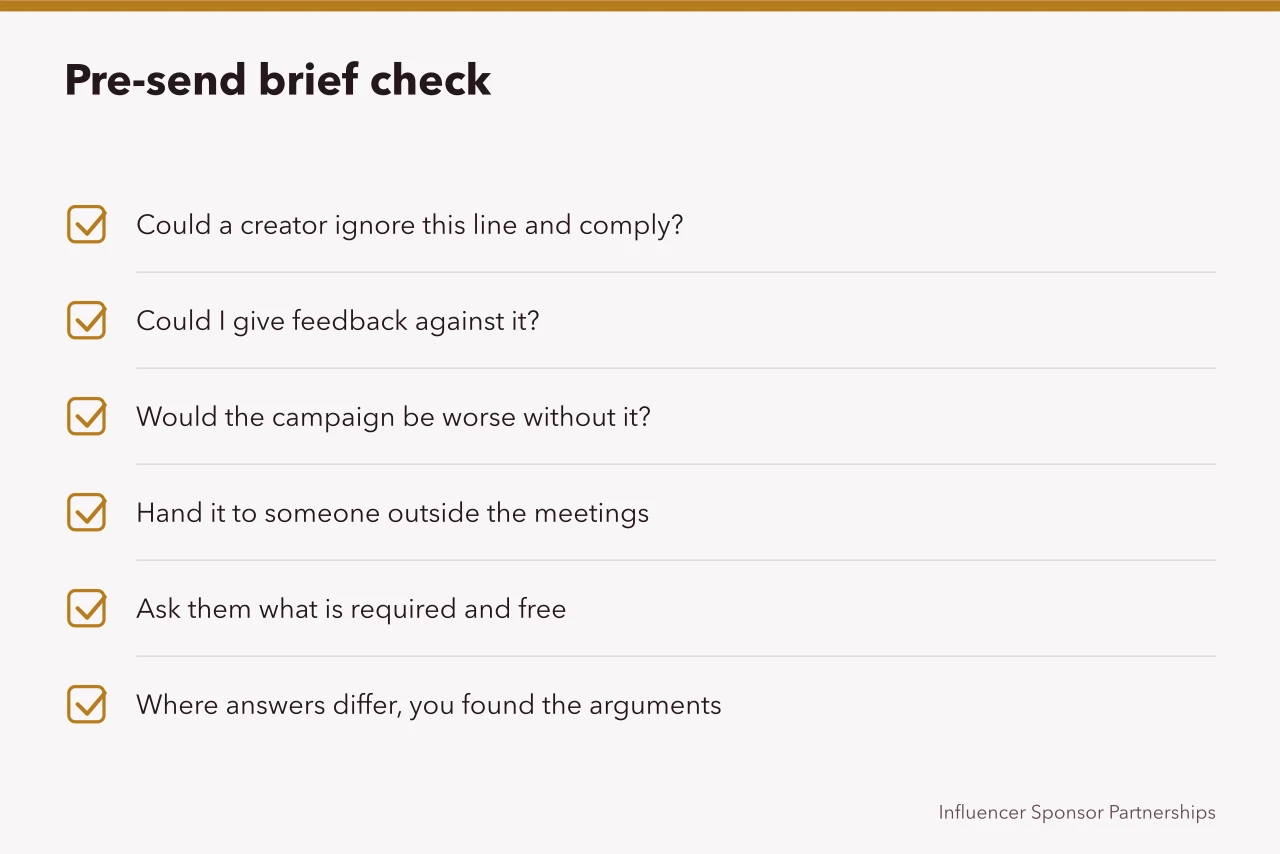
Then hand it to someone who has not been in the meetings and ask them what is required and what is free. Where their answer differs from yours, you have found the lines that will cause the arguments. The pillar on campaign briefs makes the broader case for why this is worth an hour.
Bottom line
Work backwards from the argument. Unstated mandatories, taste dressed as requirement, no example of failure, undecided claims, a late brief, and a stakeholder who was never shown it account for most approval disputes. Each has a one-line fix that costs nothing before production and a great deal afterward.
Common questions
Is it ever acceptable to add a requirement mid-campaign?
Yes, when something genuinely changes. Name it as a change, expect a schedule and cost conversation, and do not present it as a correction to the creator's work.
How do we stop briefs getting longer every campaign?
Add nothing without removing something, and check that each addition prevents a problem that actually occurred rather than one somebody imagined.
What if the creator ignores a clear constraint?
Then the feedback is straightforward and the brief did its job. That is the situation you are trying to reach.
Should the brief say what happens if the work is rejected?
The contract should. The brief can reference it, and the number of revision rounds is worth stating in both places only if you keep them synchronised.