Reviews
Part of Getting content approvals right the first time
6 things nobody tells you about content approvals rates
Content approval rates are a cost signal, not a quality score, and the six metrics that matter are the numbers brands never put in the contract.
A content approval rate is the share of submitted assets a brand signs off with no change request. It is the one number in the review stage that shows what review costs.
Six numbers sit behind it. None is a quality score. All of them are priced into the next quote whether or not anyone writes them down.
What to take away
- First-pass approval rate, rounds per asset and turnaround days are the three numbers to track per campaign and per reviewer.
- Brand-partnered social video typically clears on the first pass 40% to 60% of the time; a rate that swings by reviewer tells you more than the campaign average.
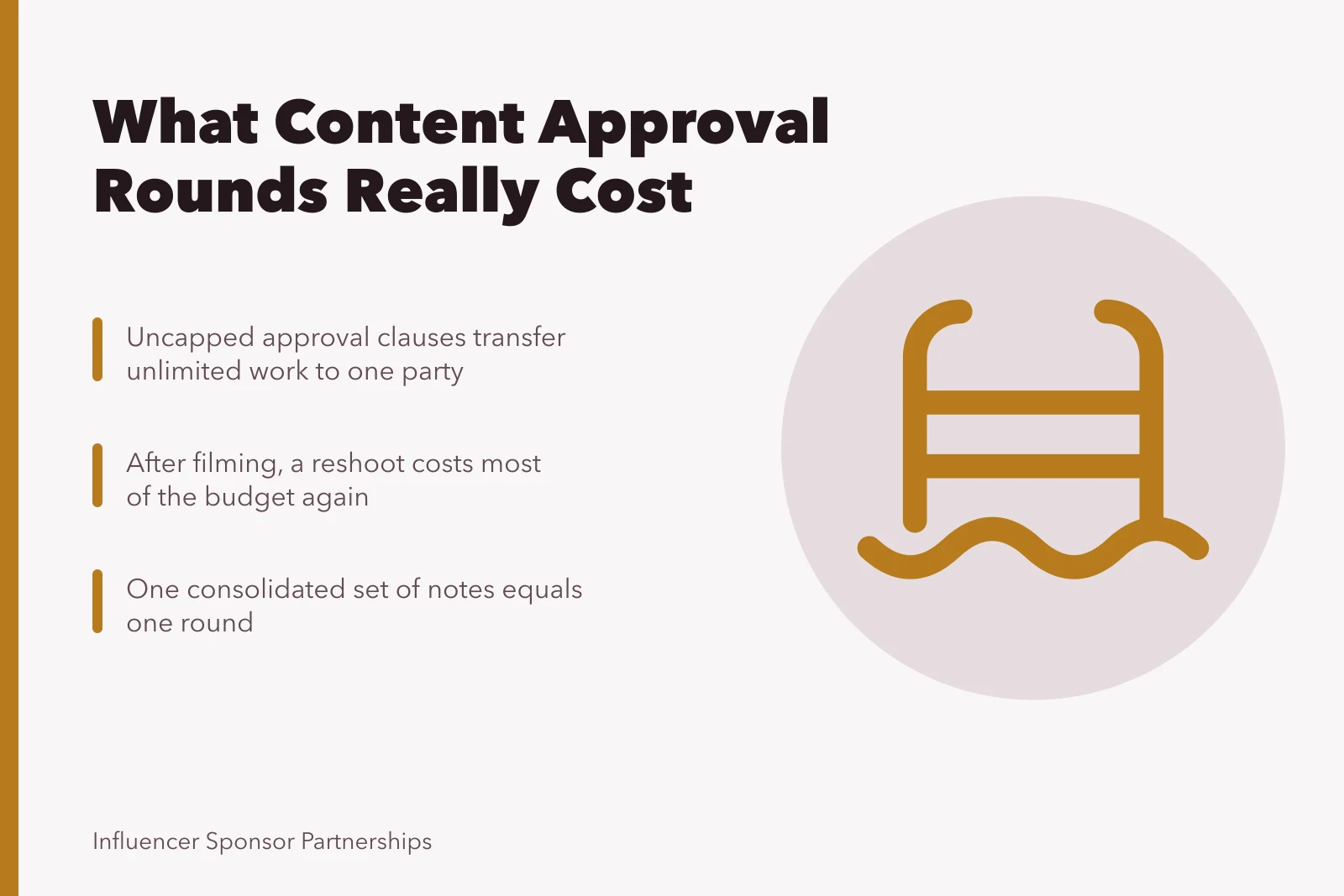
- A change at script stage costs an hour of rewriting. The same change at final cut is most of the production budget again.
- An approval clause with no round cap and no brand-side deadline transfers unlimited work to one party, and the price carries it.
- Reshoots, extra aspect ratios and new platform cuts are purchases, not revisions. Quote them as new work.
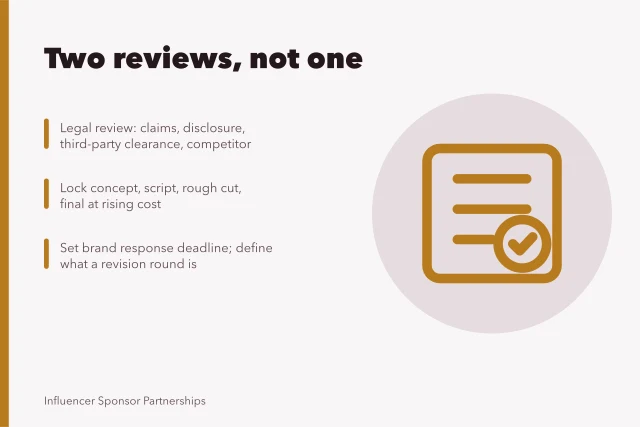
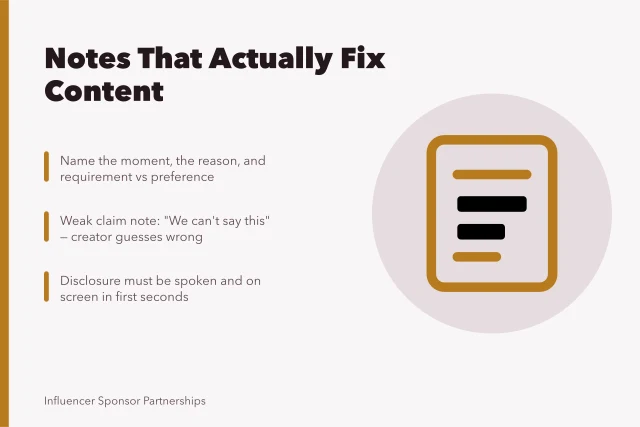
- Settle claims, clearances and disclosure placement in campaign briefs before filming, not at review.
Six numbers nobody writes into the contract
First-pass approval rate. Assets approved with no notes divided by assets submitted. In most markets, brand-partnered social video clears first pass at 40% to 60% as of 2026. Long-form brand films run lower, and single-platform cutdowns run higher. Track it per reviewer, because one harsh approver can hold a campaign average down while everyone else signs off first time.
Rounds per asset. One consolidated set of notes is a round. Three messages over four days from three people is three rounds, and if that is not written down it will be argued about. Most deals include one or two rounds in the fee, then bill the rest.
Turnaround days. Calendar days from creator submission to brand decision. Brand-side review typically takes five to ten business days, and that number, not the edit, is what moves your publication date.
Cost per round. Reviewer hours times loaded hourly rate, plus any creator fee per additional round. Three reviewers at an hour each, at a loaded $60 to $120 an hour, is $180 to $360 that never reaches an invoice.
Reshoot rate. Reshoots divided by shoots. A rising rate points at the brief, not the creator. A reshoot typically costs 60% to 100% of the original production budget again.
Change-order share. Billable changes as a share of total production spend. A low share means scope was settled early. A share above about 10% usually means the brief left a requirement open.
Review tools count the rounds for you. Filestage, Ziflow and Wipster log versions and comments, Adobe's Frame.io timestamps notes to a video frame, and social planners such as Planable hand clients a review link.
Where the cost actually sits
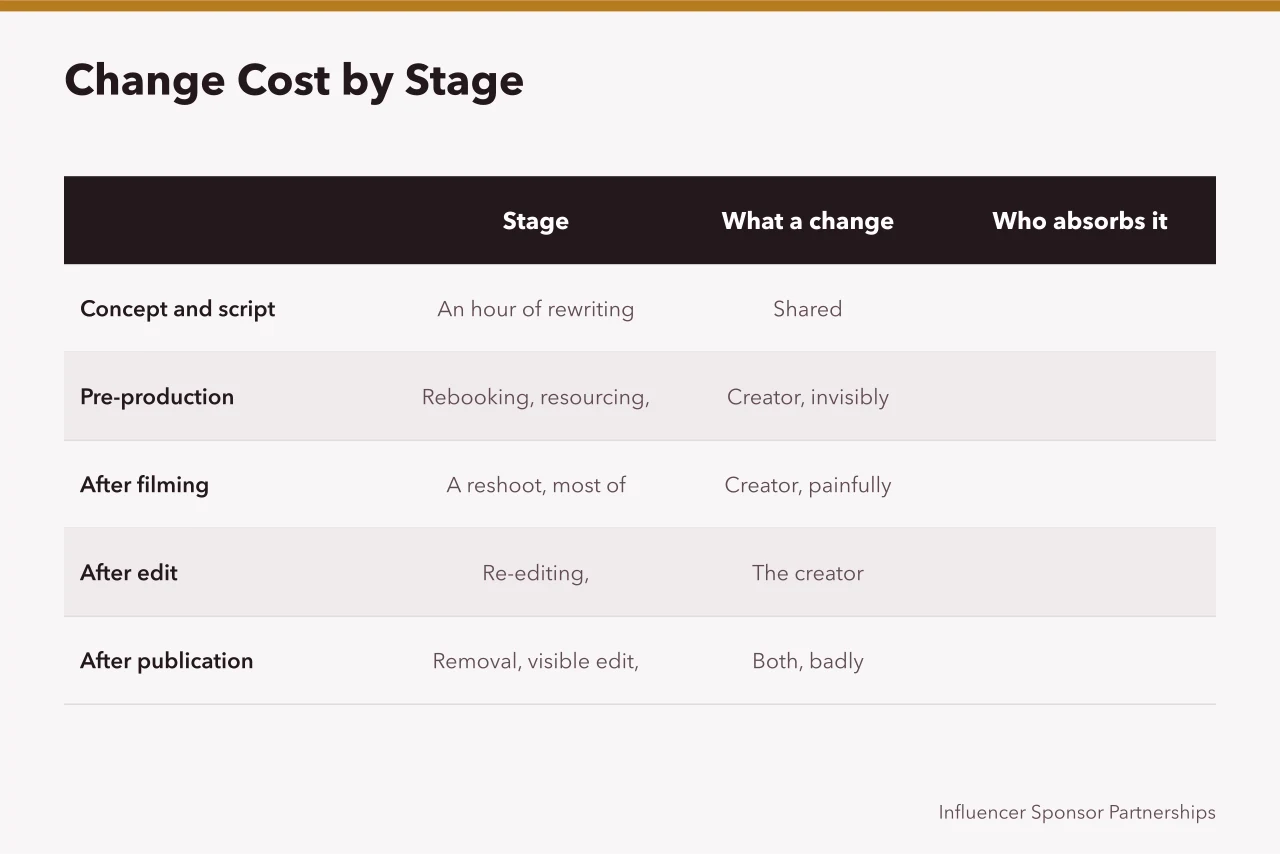
| Stage | What a change costs | Typical figure | Who usually absorbs it |
|---|---|---|---|
| Concept and script | An hour of rewriting | One to three hours, about $60 to $360 of loaded reviewer time | Shared, and it barely registers |
| Pre-production | Rebooking, resourcing, sometimes a location | A few hundred to a few thousand dollars, plus the lost slot | The creator, invisibly |
| After filming | A reshoot, which is most of the production budget again | 60% to 100% of the original production budget | The creator, painfully |
| After edit | Re-editing, and possibly re-recording audio | 10% to 25% of the edit budget, plus studio time | The creator |
| After publication | Removal, a visible edit, and reputational cost | A re-cut and a re-post, plus a missed date | Both, badly |
The shape of that table is the argument for reviewing concepts. A claim caught at script stage costs an hour of rewriting. The same claim caught at final cut costs a shoot, and everyone discovers it at the point of maximum time pressure.
How rounds get priced
The honest structures are simple, and there are five of them.
Included rounds with a per-round fee. A stated number of rounds sits in the fee, with a charge for additional ones, typically $150 to $500 for a small social deliverable and higher for video. It makes the cost of indecision visible to the party creating it.
A written definition of a round. One consolidated set of notes, delivered once. Without the definition, a round is whatever the brand says it is.
A brand-side response deadline, with deemed approval after a stated period. Without it, the creator carries an open-ended obligation and the brand carries none.
A separate line for changes that are not revisions. Additional deliverables, extra aspect ratios, new platforms, reshoots caused by something outside the creator's control.
A change-of-direction fee. Where the brief materially changes after work has started, the earlier work was still work.
The pattern is that review cost becomes visible to whoever generates it. That is not punitive. It is the only design under which a brand can decide rationally whether a fourth round is worth having.
What an unbounded clause really costs
A creator pricing unlimited revisions with no brand deadline has two options. Price the worst case, look expensive, and often lose the work. Or price the normal case and absorb the difference until the campaign that does not go smoothly.
Most price the normal case. Brands with slow, unconsolidated review are being subsidized by their partners and are receiving worse work than they think. The subsidy ends the moment the partner is busy enough to choose.
There is a second-order effect. A brand known for grinding reviews attracts the partners with nothing better on, which is a version of adverse selection. The terms select the counterparty, and not in the direction anyone intended.
The costs that never reach an invoice
Schedule. A review that adds two weeks moves a publication date, and dates are usually tied to something else that cost money.
Quality. Work that has been through six rounds is the average of everyone's caution. It is safe and it does nothing.
The relationship. Partners talk to each other. A brand that is difficult to work with finds out through its quotes long before anyone says so directly.
Internal time. Four reviewers, three rounds, one hour each, is twelve hours of salary. At a loaded $60 to $120 an hour, that is $720 to $1,440 that is rarely counted because it is not billed.
What to do about it
Price the review explicitly rather than leaving it as an assumption, and commit to the deadline that makes the price honest. The clause language is in contracts and disclosure, and the number itself in rates and negotiation.
Cut rounds by moving decisions earlier. Any requirement present at review that could have been in the brief costs you twice.
Supportable claims, unavailable words, disclosure format and the reference material the brand has in mind are all knowable before filming. How the review itself should run is in content approvals.
One requirement is not a cost to manage: a paid relationship must be disclosed so the audience notices. That check belongs in the process, not in a clause. The FTC's material on disclosures for social media influencers sets current expectations for the US market.
Bottom line
Treat review as a priced part of the deal. State the number of rounds, define a round, add a brand-side deadline, and give new work its own line.
Then cut the cost at source. A change at script stage is free. The same change after filming is not.
Common questions
Is charging for extra rounds antagonistic?
It is the opposite. It puts the cost in front of the brand at the moment the decision is being made, which is when the round can still be cancelled.
What is a normal first-pass approval rate?
For brand-partnered social video, 40% to 60% in most markets, lower for long-form. The trend per reviewer matters more than the campaign average.
What is a fair number of included rounds?
Enough for one substantive pass and one confirmation. More than that usually means the brief left something unsettled.
Who pays for a reshoot?
Whoever caused the need for it. If the creator delivered against the brief and the brief then changed, that is the brand's cost. A full reshoot typically runs 60% to 100% of the original production budget.
Does a faster review produce worse work?
A faster review with clear decision rights usually produces better work. A fast review achieved by skipping the concept stage produces the expensive kind of surprise.