Guides
FTC endorsement guides for American creator posts and licensed image reuse
Consent online for American creator posts runs through the FTC Endorsement Guides: paid posts, affiliate links and licensed image reuse all need clear disclosure.
What to take away
- Consent online is not only an image rights questionthe FTC Endorsement Guides require creators to disclose material connections in paid posts, affiliate links and licensed image reuse.
- A material connection is any brand relationship that could affect how much weight a viewer gives an endorsement, including free product, affiliate commissions and employment.
- Native advertising guidance asks creators to keep ad content visually separate from editorial content, so viewers know what they are looking at.
- FTC warning letters and Notices of Penalty Offenses show that the Commission will pursue misleading creator posts, not just the brands behind them.
What the FTC Endorsement Guides require in a creator post
The FTC Endorsement Guides are the Federal Trade Commission's rules on endorsements and testimonials. They apply when a creator has a relationship with a brand and viewers might not expect it. The Guides sit in the Code of Federal Regulations at 16 CFR Part 255, titled Guides Concerning the Use of Endorsements and Testimonials in Advertising.
The core duty is simple: disclose the connection clearly and conspicuously. A viewer should not have to guess that a post is paid, gifted or commissioned.
A creator post can be an endorsement even when the creator never says "buy this." Showing a product, tagging a brand or using a branded filter can count if the brand approved or paid for it. The Commission looks at the whole post, not one line.
The Guides apply to brands too. A brand that runs a creator campaign can be liable for what the creator fails to disclose. That is why US brand deal contracts often require disclosure language and approval rights.
For creators, the practical test is whether a reasonable viewer would understand the relationship. If the answer is no, the post needs a fix. The Commission's own Disclosures 101 for Social Media Influencers gives worked examples for sponsored posts and licensed image reuse.
Material connection: paid posts, gifted product and affiliate links
A material connection is a relationship between a creator and a brand that a viewer would not expect and that could affect the weight of the endorsement. Payment is the obvious example. Free product, commissions, contest prizes, employee status and family ties can also qualify.
Gifted product counts. A brand that sends a free item and asks for a post creates a material connection, even if no cash changes hands.
Affiliate link disclosure rules require a clear statement before the link. A creator who earns a commission on sales through a tracked link must say so. A buried "affiliate" tag in a bio or a hashtag at the end of a long caption may not be enough.
The same logic covers discount codes, referral bonuses and sweepstakes entries. If the creator gains something when a viewer acts, the connection is material. The regulation itself sits in the e-CFR table of contents for anyone who wants the rule text.
Brands should map every creator benefit in writing. A short schedule of benefits helps both sides know what must be disclosed.
Disclosure placement and language that the FTC has accepted
The Commission has published specific disclosure examples for sponsored creator content and licensed image reuse.
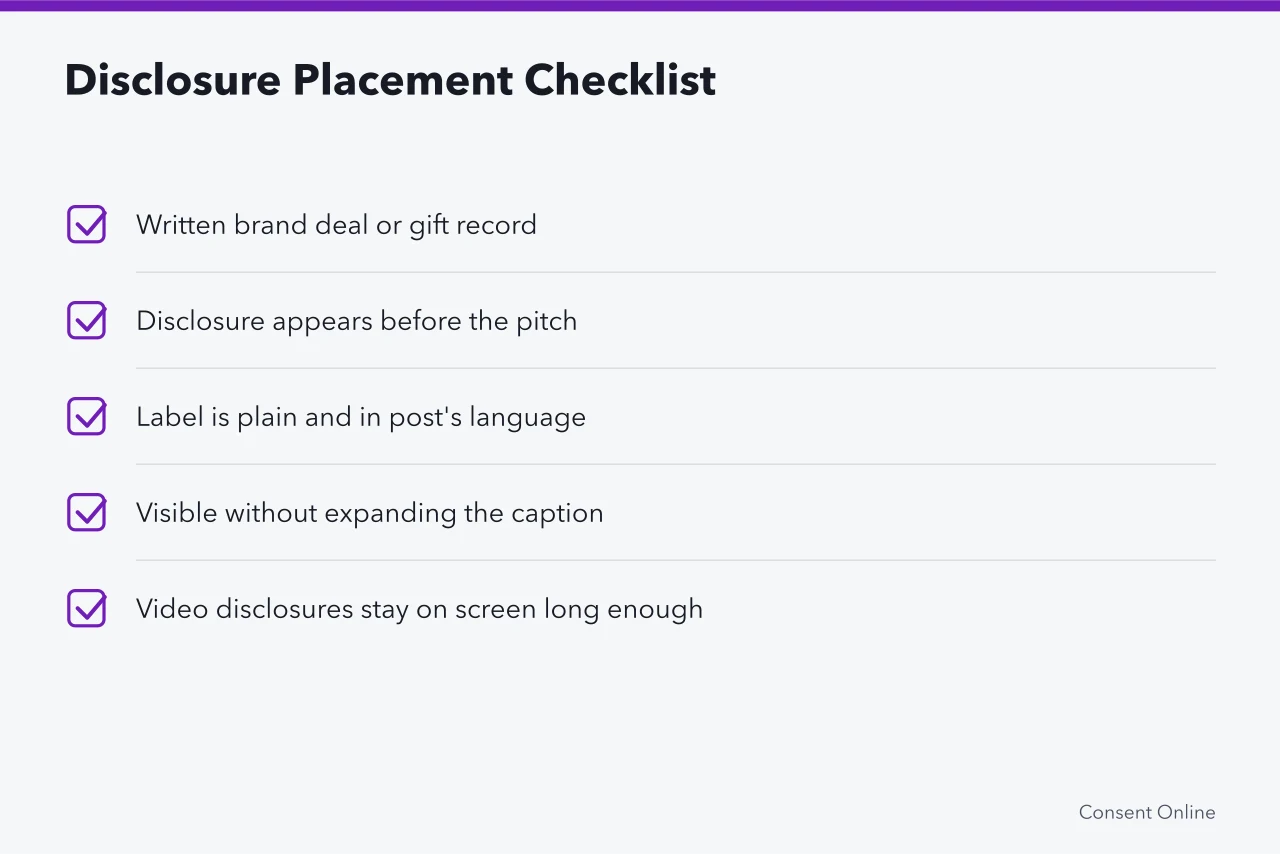
Placement rules of thumb:
Disclosure placement and language
- Put the disclosure at the start of the post or video, before the pitch.
- Keep it in the same language as the rest of the post.
- Make it visible without a clickno "link in bio" for the disclosure itself.
- Keep it on screen long enough to read in a video.
- Do not hide it behind a platform's own paid partnership label alone if that label is easy to miss.
Language that works includes "Paid ad," "Ad," "Sponsored," "#ad" and "Brand partner." Short labels near the start of a caption are accepted. Vague tags like "#sp," "#collab" or a bare brand tag are risky because viewers may not know what they mean.
Platform tools help but do not replace the creator's own disclosure. A paid partnership label is useful, yet the creator should still say the post is an ad in the caption or on screen.
A simple checklist for each post:
Native advertising and the line between editorial and ad content
Creator posts sit on the line between ad and editorial. The Commission's native advertising guidance for businesses states that a paid ad must be distinguishable from the content around it. A sponsored video that looks exactly like a creator's normal review can mislead if the sponsorship is not clear. The fix is to make the ad label obvious.
A brand logo alone may not be enough. A caption that starts with a personal story and reveals the sponsorship at the end can fail the test.
Editors and brand teams should agree on where the label goes before the creator films. A one-line approval in the contract saves disputes later.
Licensed image reuse in a sponsored post: rights plus disclosure
A licensed image is not a free pass. The license covers the right to use the image; it does not cover the duty to tell viewers about the brand deal.
Rights and disclosure are separate tracks. A license may allow commercial use, but it may also carry limits on modification, endorsement claims or paid media. Read the license before the post goes live.
Take a stock photo under a standard royalty-free license. Stock libraries sell this as a standard tier; an extended license usually adds higher ad spend and merchandise rights.
A standard royalty-free license typically permits commercial use in a social post and in paid ads up to a set spend. It usually forbids reselling the image as a product and implying that the person shown endorses the brand. The sponsored post still carries the label "Paid ad: [brand]" in the first line of the caption.
Keep a file for each licensed asset: the license, the source, the permitted uses and the ad label used in the post. That file is the creator's proof if a claim arrives.
FTC warning letters and penalty offense notices aimed at creator content
The Commission has sent FTC warning letters to creators and brands over misleading posts. In April 2017 staff sent more than 90 educational letters to influencers and marketers about disclosure on Instagram.
A follow-up round in September 2017 went to 21 influencers whose posts still buried the label. A warning letter is not a fine, but it is a public request to fix the conduct.
The Commission has used Notices of Penalty Offenses to put companies on notice that certain conduct can lead to civil penalties. In October 2021 the notice concerning endorsements went to more than 700 companies.
In April 2023 a notice on substantiation of claims went to more than 670 companies. Civil penalties are set by statute and adjusted each January; the maximum stood at roughly $53,000 per violation in 2025.
The pattern is consistent: the Commission targets ads that look organic, endorsements without disclosure and claims that cannot be supported. Creator posts are part of that enforcement picture.
Brands and creators should treat a warning letter as a compliance prompt. Review past posts, fix live ones and update the brief for future campaigns.
Building a consent online disclosure routine for US brand deals
A routine beats a one-off fix. US brand deals move fast, and disclosure rules apply in every state, from California and New York to Texas, Florida and Illinois.
A workable routine has five steps.
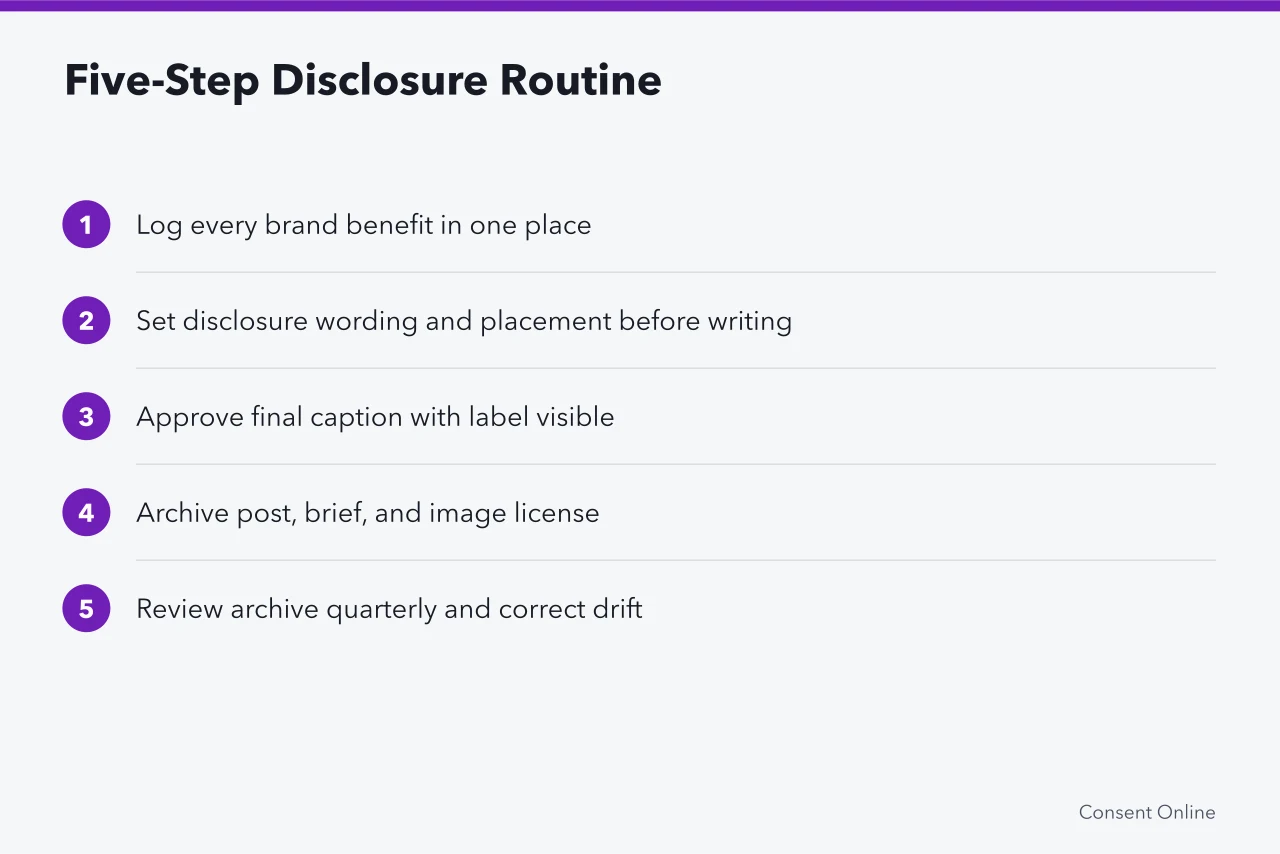
- List every benefit in the deal: cash, free product, discounts, travel, affiliate commission and contest prizes.
- Write the required label into the contract, including where it sits and when the brand approves it.
- Draft the caption or script with the label in the first line, before any pitch.
- Check the post on a phone with the caption collapsed before you publish.
- File the brief, the final label text, the post screenshot and the license terms for any image used.
A worked example: a Texas creator gets a free skin care set and a 10% affiliate code. The post opens with "Paid ad: [brand] sent me this set, and I earn a commission on code." The disclosure is first, in plain English, and the code sits below it.
The creator saves the brand email, the code terms and the post screenshot. If the brand later asks for a licensed photo of the creator to run as a paid ad, the creator checks the license and adds the ad label to that asset too.
For creators who appear in synthetic or computer-generated ads, the same disclosure logic applies. A fictional endorsement built from a creator's likeness can mislead viewers and trigger both FTC and state right of publicity issues.